Source and verification
This article explains family 147 of the October 6, 2026 OpenAI collection. Research conclusions are attributed to its manuscripts. The review covers statements, introductions, and selected proof mechanisms; it is not an independent verification of the complete proofs.
🏷️ Billiards, phase curves, and caustics
Let be a bounded strictly convex domain with smooth boundary and everywhere positive curvature. A billiard particle travels on straight segments and reflects by
where is the outward unit normal at impact.
Using boundary arclength and outgoing angle from the positive tangent, the billiard map acts on the phase cylinder . The grazing boundary is .
A caustic is a closed convex curve inside the table such that a trajectory tangent to it stays tangent after reflection. It is a physical curve in the table; an invariant phase curve instead lives in the two-dimensional space of collision data. Relating these two objects is a main task of this family.
🏷️ Two formulations of near-boundary rigidity
The physical-collar manuscript assumes a continuous family of smooth strictly convex caustics filling a neighborhood of the boundary. More precisely, there is a homeomorphism from onto a relatively open collar, with zero leaf and positive leaves smooth caustics. It claims that is an ellipse. (OpenAI, 2026)
The phase-foliation manuscript starts from weaker leaf regularity:
Phase formulation in the manuscript
Suppose an invariant open annulus contains every phase point with for some , and is homeomorphic to through a foliation by individually invariant essential simple closed curves. Then is an ellipse. Only continuity of this foliation is assumed. (OpenAI, 2026a)
“Essential” means that a curve winds around the phase cylinder rather than bounding a disk in it. Circles are included among ellipses.
Both formulations require a full collar, including all intermediate leaves. A Cantor family with gaps, even one accumulating at the boundary and having positive measure, does not satisfy this hypothesis. The dynamics farther inside the table is not required to be foliated.
🏷️ The ellipse model
For an ellipse with semiaxes , the confocal curves
are elliptic caustics. For small they fill a collar of the outer ellipse. The corresponding circle model uses concentric circles.
These examples show that the conclusion is compatible with the local grazing hypothesis. A theorem requiring a foliation of the entire phase cylinder would have a different strength and can force the more restrictive circular geometry.
No closeness to an ellipse, central symmetry, or analyticity of the initial boundary is assumed in the two source statements. Analyticity is an intermediate conclusion.
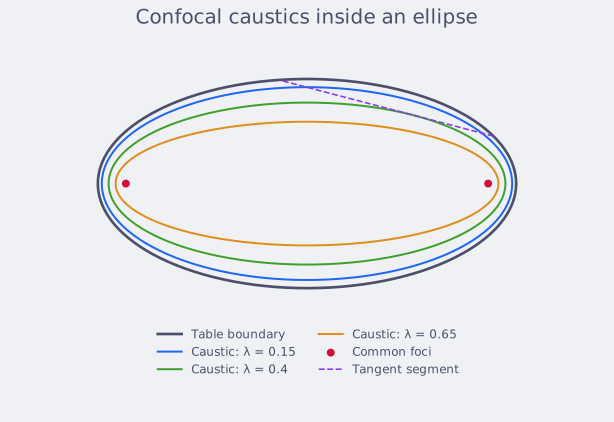
The plotted curves have semiaxes determined by the displayed formula and share the same foci. The dashed segment is tangent to one caustic. This illustrates the elliptic model; it is not evidence for the general rigidity claim.
🏷️ From continuous phase leaves to periodic graphs
A continuous essential phase curve need not initially be described as a smooth graph. The first manuscript uses two twist inequalities for billiard dynamics together with finite-area recurrence to rule out vertical pairs and obtain graph leaves.
At rational rotation numbers, recurrence excludes plateaus and produces a unique invariant graph filled by periodic trajectories. This is stronger than the existence of a few periodic points on the graph. It is the uniform family of periodic trajectories that makes their action independent of the starting point. (OpenAI, 2026a)
For a closed reflected polygon, action is its total segment length. Stationarity of this length expresses the reflection law: varying an impact point tangentially makes the incoming and outgoing tangential components agree.
The manuscript turns the constant actions of rational periodic graphs into high-frequency equations for the boundary. Their derivative has a leading high-mode projection and a small remainder. A Newton construction on shrinking complex strips gives an analytic solution, and a real contraction argument identifies it with the original smooth data.
🏷️ Joint regularity and a physical collar
Analyticity of the boundary alone does not automatically produce jointly analytic caustics. Near rational resonances, Fourier division leaves coefficients that cannot be controlled by residual values alone.
The source uses both residual values and their first derivatives in the rotation parameter. Those first jets permit a second division and a quadratic Newton improvement. The loss exponent is fixed before choosing the order of formal initialization, avoiding a circular order of parameter choices.
The resulting invariant line graphs yield analytic support functions. Positive curvature radii and a strictly decreasing support displacement produce nested convex envelopes filling a physical collar. The first manuscript thereby establishes the hypothesis of the physical-collar theorem before invoking it.
Some analytic estimates are imported from the physical-collar companion, but those estimates are stated for arbitrary inputs. Their use in the regularity reduction does not presuppose the geometric collar that is being constructed.
🏷️ The physical-collar rigidity mechanism
The second manuscript first derives analytic boundary and grazing parametrizations from the full physical collar. It then continues reflected chains in complex variables. Finite endpoint-jet data determine intermediate lines, providing a local control on continuation. (OpenAI, 2026b)
A hypothetical first obstruction to continuation is studied through a complexified normal and derivative fields. Zeros or poles of the normal force the elliptic alternative. Otherwise a shape coordinate organizes the remaining possibilities.
Growth estimates reduce the obstruction to a critical finite-width case. Moment bounds and paths through regions of large derivative fields give a bound on total angular change. For an odd periodic chain, matrix identities transfer that control to stopped Brownian paths before the hypothetical boundary.
A horizontal-row sign argument finally keeps the last moving impact away from that boundary, contradicting the assumed first obstruction. The source separates a forward-referenced exclusion lemma from the angular estimate that later uses it; the exclusion is claimed from earlier continuation and moment estimates.
These analytic continuation and probability arguments are the substantial rigidity proof. The elementary reflection formula and the ellipse model do not independently verify them.
🏷️ Key steps and proof outlines
Stationary chains give an onto invariant line graph
The phase-foliation paper first obtains a joint analytic solution of the reflected-chain stationarity equation. Let be its boundary angle, with and , and let be the billiard generating function in line coordinates. Define
The stationarity equation is . The generating relation then gives
Thus the graph is invariant onto itself, since its parameter dynamics is circle translation. This is stronger than checking that each line has one reflected successor somewhere in the family. The joint analytic construction producing remains an essential source theorem; the following geometric argument explains how its output supplies the physical-collar hypothesis. (OpenAI, 2026a)
The correct collar parameter is the square of the step
Let be the boundary support function and its curvature radius. Antisymmetry of the generating function and stationarity make both and even in . If , the line-coordinate expansion is
Evenness improves the final expansion in to
An even analytic function of is analytic in . Inverting the angular map gives a support candidate with . The expansion is at fixed physical normal angle after inversion, so a change of parametrization cannot eliminate the inward motion. For a sufficiently small common interval, , , and uniformly.
The envelope is a genuine nested convex curve
With and , set
Differentiation gives . For any fixed normal angle , the derivative of has the sign of , so its unique maximum is at and equals . Hence every envelope point lies on the boundary of and satisfies all its support inequalities.
Conversely, at a boundary point , the nonnegative function has a zero minimum. Its value and derivative there identify with . This proves that the envelope is the entire boundary, with positive curvature and no repeated contact point. The uniform negative gives strict nesting and a nonvanishing transverse derivative; together with the angular derivative, it makes the family a collar rather than a collection of possibly touching curves. The onto graph invariance makes reflected tangent lines remain tangent, proving the caustic property.
The two analytic stages have separate obligations
Before this envelope argument, continuous phase leaves must become graphs and rational leaves must consist entirely of periodic trajectories. Their constant actions supply the high-frequency equations used to regularize the boundary. Joint regularity then requires residual values and first rotation-parameter derivatives at resonances; residual values alone leave uncontrolled Fourier divisors. The initialization order is chosen after fixing those derivative-loss estimates.
After the collar is obtained, the physical-collar companion supplies the separate rigidity theorem. Its endpoint-jet continuation, obstruction classification, angular bounds, and final sign argument must exclude a first failure of complex continuation. The support calculation above establishes its geometric hypothesis, but does not prove that continuation theorem. Keeping this interface explicit avoids assuming the physical collar during the phase paper’s regularity argument, or mistaking the elementary ellipse example for a proof of rigidity. (OpenAI, 2026b)
See Also
Irrational triangular billiards studies ergodicity in polygonal tables, where corners replace smooth positive curvature. Hamiltonian ray reconstruction uses boundary ray data for an inverse problem rather than an integrability classification.
🏷️ Manuscripts and verification scope
- Continuous Phase Foliations Create Analytic Caustic Collars — pinned manuscript and companion source.
- Rigidity of Smooth Billiards with a Continuous Caustic Collar — pinned manuscript and companion source.
No family scope page was present at lean/docs/147.md in the pinned snapshot. This does not establish that all related formalization code is absent. No Lean build, axiom audit, or manuscript-to-formal-statement equivalence check was performed for these notes.
OpenAI collection provides prerequisites and the reading sequence; coverage register records completed and pending families.