Overview
Brittenham and Hermiller prove that unknotting number is not additive under connected sum (Brittenham & Hermiller, 2026). Their central example is
where is the -torus knot. Since
the standard connected-sum argument gives . The new point is an explicit unknotting sequence with only five crossing changes:
This gives a negative answer to Question 1.69(B) in the Kirby problem list (Kirby, 1997).
Unknotting Number and Additivity
A knot is an isotopy class of embeddings
A crossing change in a knot diagram switches which strand passes over the other at a single crossing. The unknotting number of a knot is
The mirror image of is denoted . Mirror reflection preserves unknotting number:
The connected sum is formed by cutting a small arc from each knot and reconnecting the four loose ends. It is immediate that
because one may unknot the two summands separately inside a connected-sum diagram. The additivity question asked whether equality always holds:
Brittenham and Hermiller show that this equality can fail.
Signature Bounds and the Mirror Sum
One reason additivity looked plausible is the behavior of the knot signature. Signature is additive under connected sum and changes sign under mirroring:
Murasugi proved the lower bound (Murasugi, 1965)
For , the paper uses
Hence . The standard diagram of can be unknotted by three crossing changes, so
Equivalently, this follows from the Kronheimer-Mrowka theorem for torus knots (Kronheimer & Mrowka, 1993):
The same signature bound proves additivity for :
so
Thus
For the mirror sum, however, the signature cancels:
The classical lower bound therefore gives no obstruction to a shorter unknotting sequence.
Mechanism of the Counterexample
The proof does not need to compute exactly. To disprove additivity it is enough to produce one route to the unknot with fewer than
crossing changes. The signature calculation explains why this was hard to see by classical lower bounds: the summands individually have signature obstruction , but the mirror sum has signature zero.
It is useful to view the argument in the Gordian graph, whose vertices are knots and whose edges are crossing changes. The theorem exhibits a path of length from
to the unknot. The intermediate knot names are not decorative; they are waypoints that make the path checkable. Each arrow is a concrete crossing change followed by isotopy and identification of the resulting knot.
Thus the mechanism is a certificate of a strict upper bound:
The lower-bound machinery only has to establish that the two summands each have unknotting number . The nonadditivity itself comes from the explicit five-step route through the Gordian graph.
Explicit Five-Crossing Sequence
The proof is an explicit certificate. The authors start with a diagram of
realized as the closure of the braid word
Changing the signs of the first two entries produces a braid whose closure is identified by SnapPy as
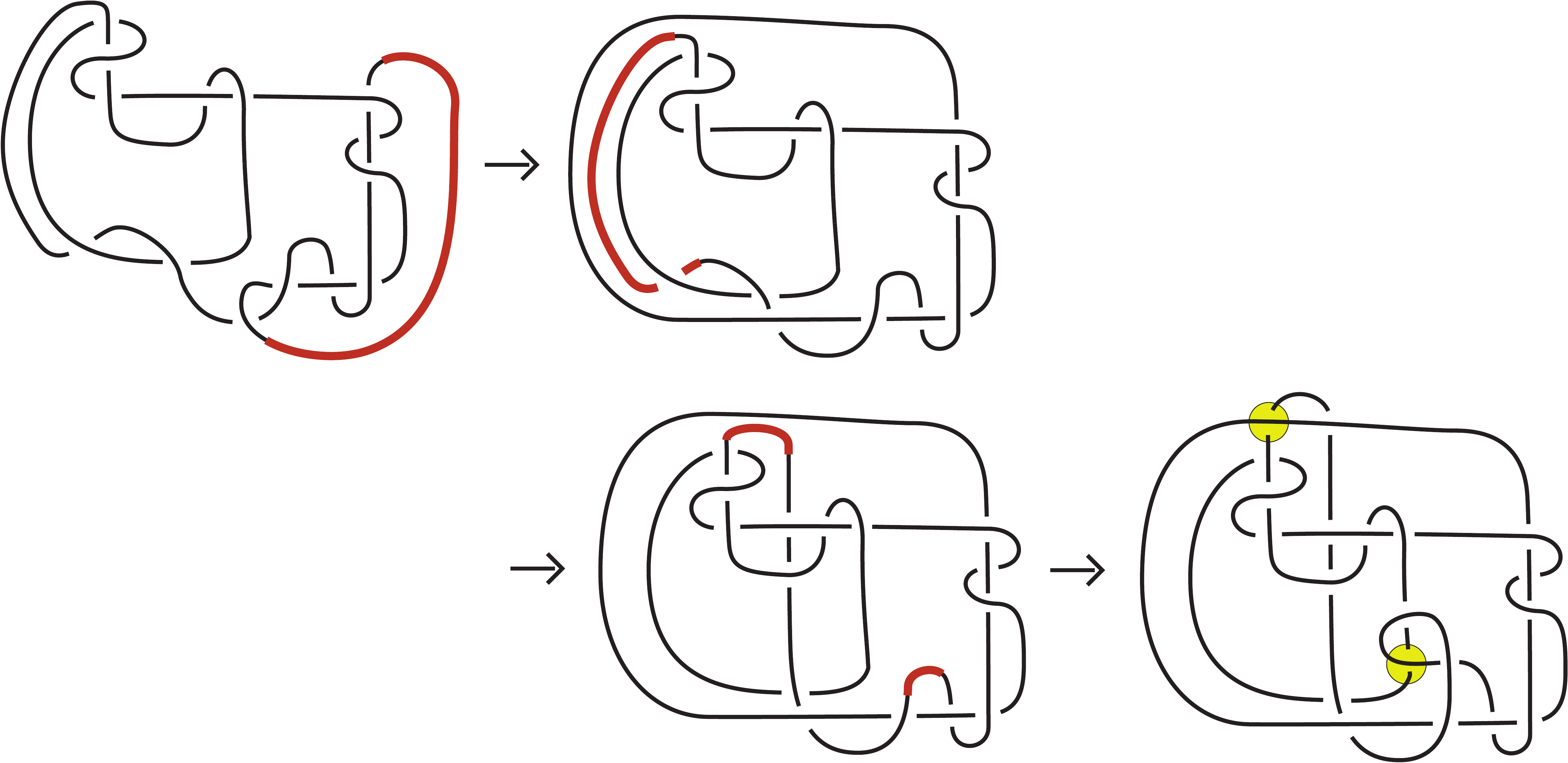
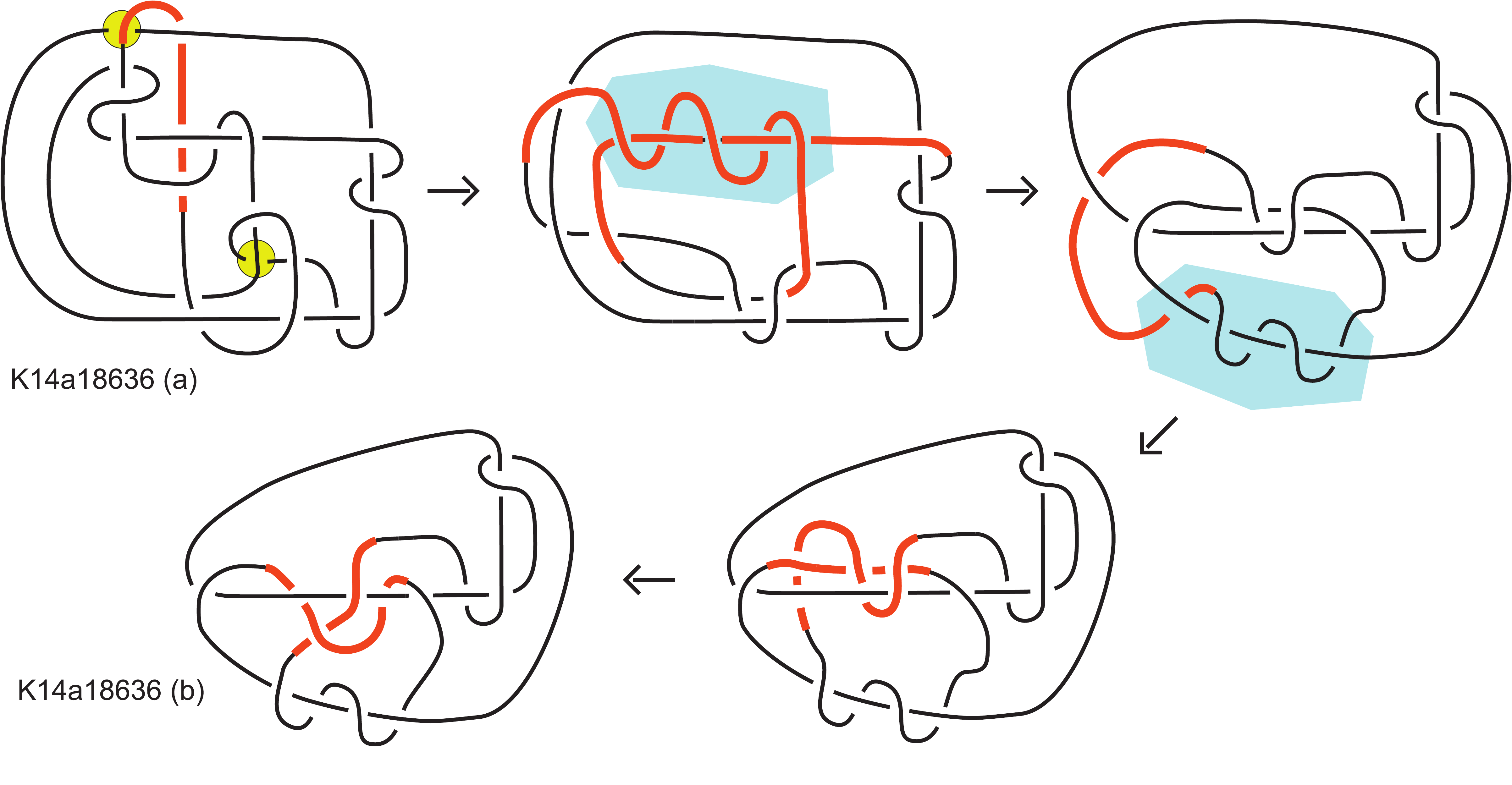
Figures 1 and 2 account for the first two crossing changes, so
It remains to show
The next diagrammatic step changes one crossing in a diagram of to obtain
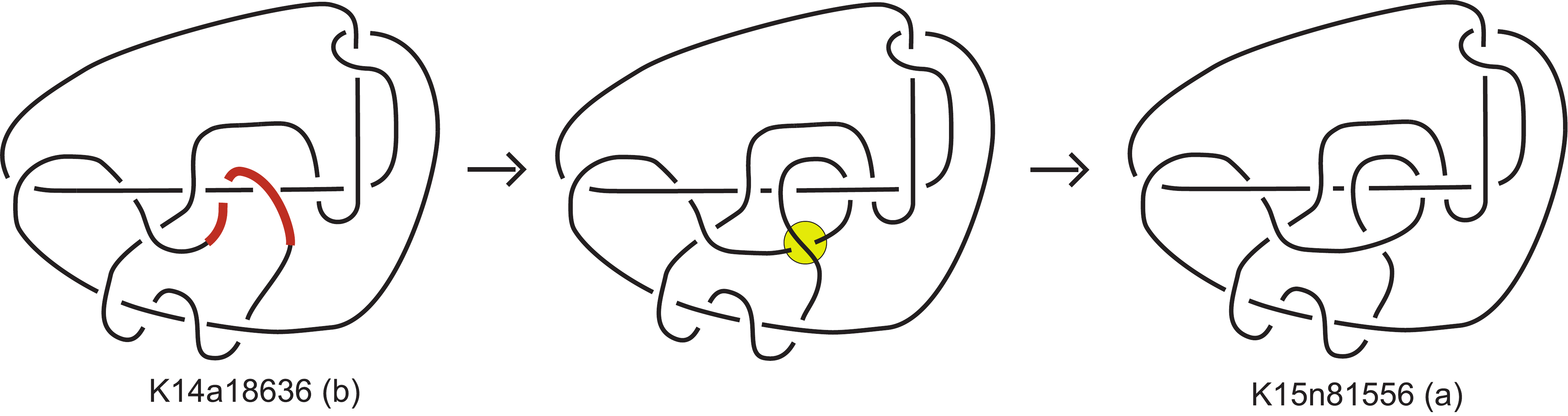
A different diagram of is then one crossing change away from
Finally, has unknotting number one, as recorded in KnotInfo (Livingston & Moore, 2025).
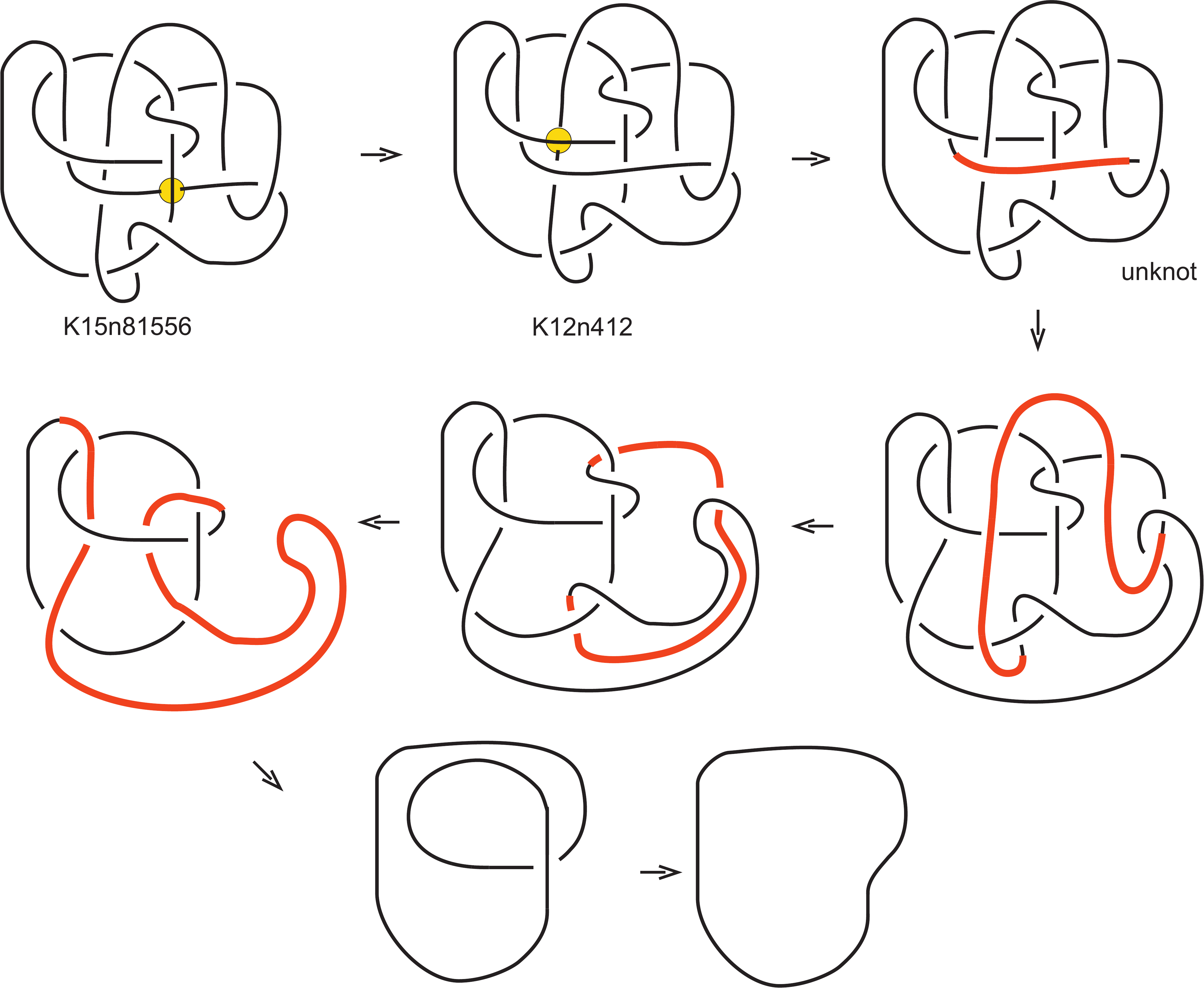
Combining the diagrammatic steps gives
The labels record the number of crossing changes, with isotopies allowed between them. Hence
Since
this proves nonadditivity.
Exact value not determined
The paper does not determine the exact value of
It proves the upper bound . The knot is nontrivial, so its unknotting number is not ; it is also composite, while Scharlemann proved that knots of unknotting number one are prime (Scharlemann, 1985). Therefore the paper gives the range
The exact value could be , , , or .
Gordian Adjacency and Infinite Families
The finite example is the starting point for much larger families. The organizing notion is Gordian adjacency. A knot lies on a minimal unknotting sequence for a knot if
and can be changed into using exactly
crossing changes.
Suppose lies on minimal unknotting sequences for and . Then the five-crossing certificate for can be inserted into an unknotting sequence for
First reduce to and to inside the connected sum. This costs
crossing changes. Then use the five-crossing sequence for . Altogether,
So additivity fails for such pairs.
The construction is functorial at the level of unknotting paths. A minimal path from to and a minimal path from to can be run inside the two summands of
Once the connected sum has been reduced to , the special five-crossing certificate saves one crossing relative to unknotting the two summands separately. This is the mechanism behind all the families: the finite defect for is inserted into longer minimal unknotting sequences.
For two-strand torus knots,
one has
Changing crossings in the standard diagram reduces to
Therefore, for all ,
The same idea combines with known Gordian-adjacency results for torus knots. The paper obtains nonadditivity for any pair in
Thus nearly every torus knot can appear as a summand in this construction.
There are also non-torus examples. The knot has unknotting number and is one crossing change away from in the relevant direction. Hence the paper obtains
and
Two large-scale consequences are worth recording separately.
Fixed unknotting number
For every , there are infinitely many knots with
and
for all .
Arbitrarily large failure
For every , there are infinitely many knots with
Group-Theoretic Consequence
The result also shows that the knot group alone does not determine unknotting number. The knot group
does not distinguish a summand from its mirror in a connected sum in the way unknotting number can.
In particular,
But the unknotting numbers differ in the only direction needed here:
Therefore the knot group is not enough information to recover .
Computational Role
The discovery was computational, but the proof is diagrammatic. The search used SnapPy and SnapPea (Culler et al., n.d.) to randomize diagrams by Reidemeister moves, convert diagrams to braids, change signs in braid words, and identify the resulting knots.
The original project concerned mutation questions for unknotting number, not additivity. The authors generated connected sums that, under the additivity conjecture, should have had large unknotting number. One generated path unexpectedly led from to , and then from to a knot with a shorter known route to the unknot. After simplification, the useful braid for had only crossings.
The final theorem is not a numerical experiment. Computation found the certificate; the proof consists of explicit diagrams, crossing changes, isotopies, and computer-checkable knot identifications. The computational step has two logically separate roles: it searches the Gordian graph for a short path, and it identifies the intermediate knots once a path is found. The mathematical certificate is the resulting finite list of moves and identifications.
Open Problems
The first remaining question is numerical:
The current bounds from the paper are
A second question asks whether a connected sum can ever have smaller unknotting number than one of its summands:
Nonadditivity does not answer this. The example only shows that a connected sum can have unknotting number smaller than the sum of the two summand values.
The broader structural question is whether every nontrivial knot admits a partner that defeats additivity, or whether some knots remain universally additive:
The large torus-knot family also leaves small boundary cases:
These knots cannot have on a minimal unknotting sequence for simple unknotting-number reasons, so they require different methods.
See Also
- on Burau faithfulness for four strands: Another low-dimensional topology result proved by converting geometry into a finite certificate.
- on self-avoiding walks and the honeycomb connective constant: Shares the theme that local moves and cancellations can control a global invariant.
- on improved Nyström bounds: A contrast from numerical linear algebra, where structured finite data produce reliable global bounds.