Overview
The Burau representation is a classical linear representation of the braid group over Laurent polynomials. Bharathram, Birman, and Brendle prove that the four-strand Burau representation is faithful (Bharathram, Birman & Brendle, 2026). Together with the known faithful cases and the known nonfaithful cases , this gives the complete classification:
The proof converts the kernel question into a controlled non-cancellation problem. A braid in the Burau kernel would force certain signed Laurent polynomials, computed from intersections of arcs in a punctured disk, to vanish. The paper develops enough disk-sequence topology to show that the required cancellation cannot occur in the four-strand case.
Faithfulness and the Burau Kernel
A representation of a group is faithful if it is injective. For the Burau representation this means
for every braid . Equivalently,
In concrete terms, the Burau representation assigns to each braid a matrix with entries in . Faithfulness asks whether this matrix-valued invariant distinguishes braids without ambiguity. If two braids have the same Burau matrix, then
Thus faithfulness is precisely the assertion that no nontrivial braid is invisible to the representation.
This post follows the convention used by Bharathram, Birman, and Brendle: denotes the unreduced Burau representation
Some classical references phrase the same problem for the reduced Burau representation. The two formulations are equivalent for faithfulness, but the unreduced convention is the natural one for the topological model used below.
Strand-Number Classification
Let be the braid group on strands. Burau introduced the representation in 1935 (Burau, 1935). Before the new theorem, every strand number except had already been settled.
| Strands | Status | Reason |
|---|---|---|
| faithful | is trivial. | |
| faithful | , and the generator has nontrivial Burau image. | |
| faithful | Magnus-Peluso proved this algebraically; the new paper also gives a topological proof (Magnus & Peluso, 1969; Bharathram, Birman & Brendle, 2026). | |
| faithful | This is the theorem of Bharathram-Birman-Brendle. | |
| not faithful | Moody proved nonfaithfulness for , Long-Paton improved this to , and Bigelow proved (Moody, 1991; Long & Paton, 1993; Bigelow, 1999). |
The stabilization property explains why the faithful range cannot reappear at larger : once a nontrivial kernel element exists, adding an extra strand preserves kernel membership.
Topological Construction
Let be a disk with marked points
in its interior. The braid group is identified with the mapping class group
where homeomorphisms preserve the boundary and may permute the marked points. This viewpoint lets a braid act directly on arcs in a punctured disk.
Fix a basepoint on . Let
be the standard free generators of , with looping once around . The homomorphism
sends a word in the to its total exponent sum. Let be the corresponding cyclic cover, whose deck group is generated by . The relative homology module
is free of rank over . The induced braid action on this module is the unreduced Burau representation. This is the standard topological construction of Burau (Birman & Brendle, 2005).
Stabilization of kernel elements
If is induced by adding one puncture, then
The four-strand proof uses this contrapositive style of reasoning: a carefully chosen five-strand test can rule out a hypothetical four-strand kernel element.
Moody Polynomial
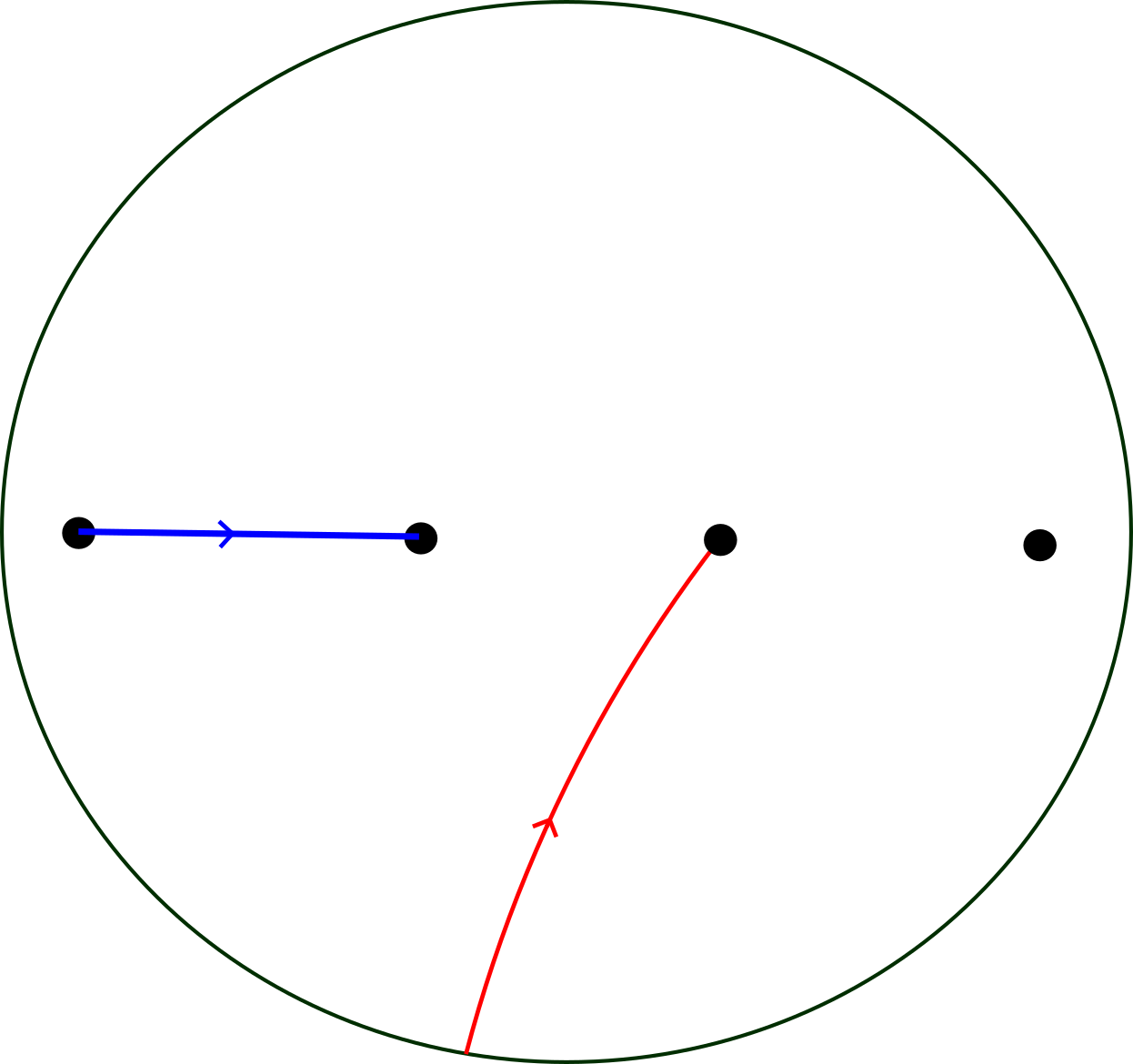
Figure notation
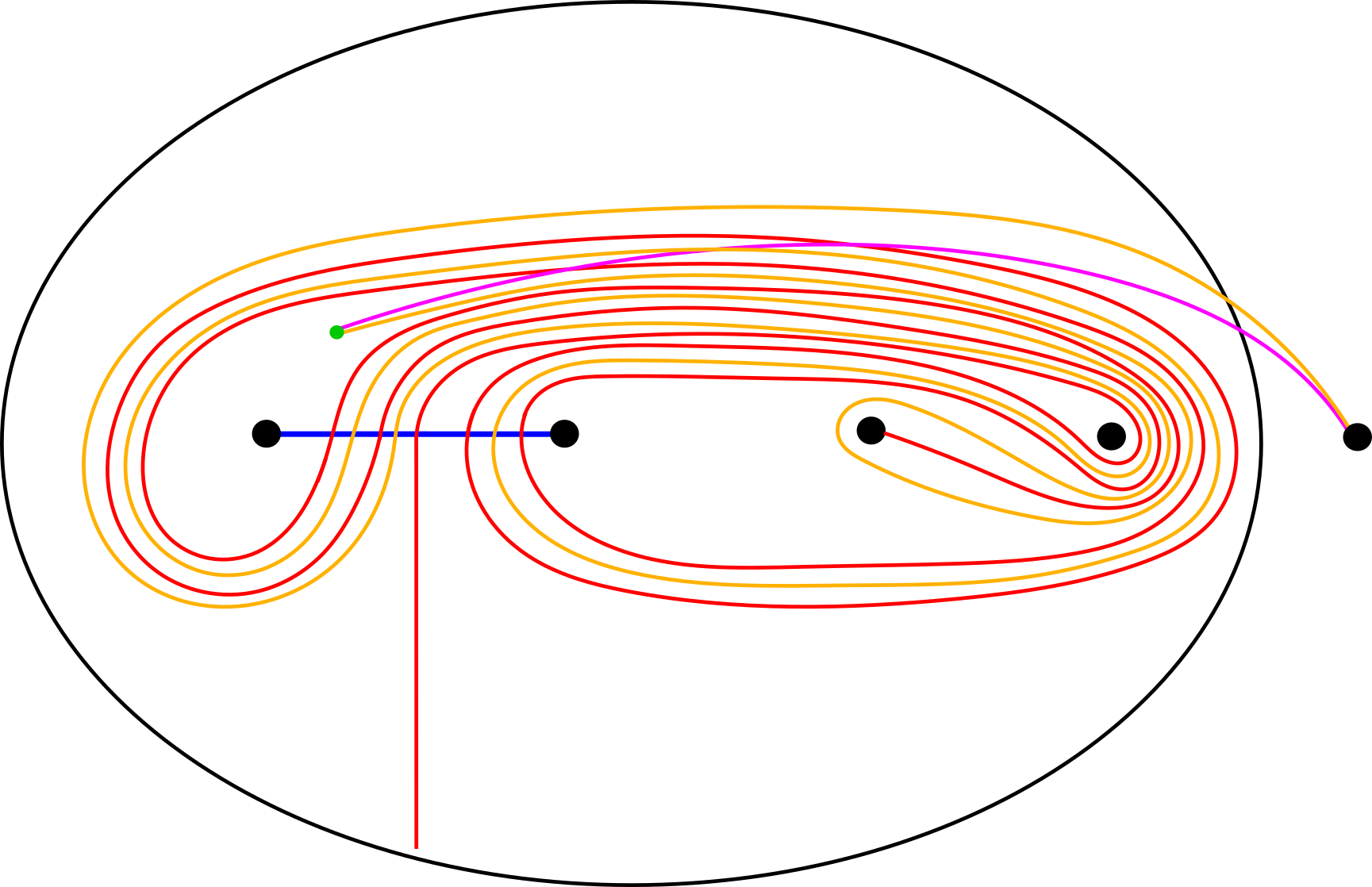
In the figures, blue denotes the fixed measuring arc , red denotes the test arc obtained from by a braid action, and gold denotes a point-pushing loop. The diagrams record red-blue intersections and the signed Laurent monomials associated with those intersections.
The first reduction replaces a matrix calculation by an intersection calculation. Fix the arcs shown in Figure 1. The blue arc joins to , and the red arc joins the boundary basepoint to . For a braid , write
The question is whether the moved arc can intersect in a way that is invisible to Burau.
Choose lifts . The Moody polynomial is
where the coefficient is the algebraic intersection number in the cyclic cover.
There is also a planar description. Put
ordered along from to . Each crossing contributes a signed monomial
so that
The unsimplified polynomial records every crossing. The simplified polynomial combines equal powers of . Therefore cancellation can occur only when two distinct crossings have the same exponent and opposite signs.
For a braid , define
Moody obstruction
For , if , then .
More generally, if for some ,
then .
The second form is essential in the four-strand argument. The proof does not always detect directly; instead, it appends a test braid and shows that changes the Moody polynomial of that test.
Mechanism of the Moody Test
The Moody polynomial is a compressed homological pairing. The Burau representation is the action on the relative homology of the cyclic cover, and the lifted intersection pairing records how a moved test arc pairs with the fixed measuring arc. If a braid lies in the Burau kernel, then it acts trivially on this homology module. Consequently, every homological intersection invariant computed from a test arc must agree before and after applying .
This is why the strengthened obstruction is useful. If
then cannot act trivially on Burau homology: the auxiliary braid has made the invisible action visible. The proof is allowed to choose such a because kernel membership would force equality for every test. In this sense, the argument is a separating-family argument: the Moody polynomials produced by suitable arcs and point-pushes separate a nontrivial Brunnian braid from the identity.
Disk Sequences and Cancellation
The exponents are controlled by the disks between consecutive crossings. Between and along , let be the red subarc and let be the blue subarc with the same endpoints. Together they bound a disk
If contains punctures, define
The list
is the winding number sequence, and
is the disk sequence.
Bigelow exponent rule
If is the exponent contributed by , then
Consequently,
Repeated powers of can occur only across a consecutive block of disks with total winding zero. The proof therefore becomes a question about whether such a block can contain an odd number of sign reversals.
A disk is sign-changing if adjacent crossings have opposite signs,
and sign-preserving otherwise. The parity condition is
where is the set of punctures inside .
Parity criterion
If a braid satisfies the parity condition, then its Moody polynomial has no cancellations. Hence any such braid with is not in the Burau kernel.
Indeed, if , then
Since , this zero sum has even parity. Under the parity condition, the odd-puncture disks are exactly the sign-changing disks. Thus there are an even number of sign changes between and , so
Equal powers of have equal signs and cannot cancel.
The mechanism can be summarized as follows. Equal exponents in the Laurent polynomial are detected by zero total winding. Opposite coefficients are detected by sign changes. The parity condition synchronizes these two pieces of information: any zero-winding block contains an even number of sign changes, so equal exponents have equal signs. The proof therefore converts cancellation in into a parity statement about punctures in disks.
The Three-Strand Case
For , every disk in a disk sequence contains , , or punctures. Minimal position forces the following behavior.
| Punctures inside | Effect on signs |
|---|---|
| or | sign-changing |
| sign-preserving |
This is exactly the parity condition. Therefore every -strand braid satisfies the parity criterion, and Moody polynomial cancellation cannot hide a nontrivial kernel element. This recovers the Magnus-Peluso faithfulness theorem for by a topological argument.
The obstruction in is now precise. Four-puncture disks introduce sign behavior that is not determined solely by parity, so the three-strand argument has to be refined rather than copied.
Reduction to Brunnian Braids
For a marked point , the Birman exact sequence identifies the point-pushing subgroup with a punctured-disk fundamental group:
A loop based at gives a braid by pushing the marked point around the loop (Farb & Margalit, 2012).
The Brunnian subgroup is
Equivalently, a Brunnian braid becomes trivial after forgetting any one strand.
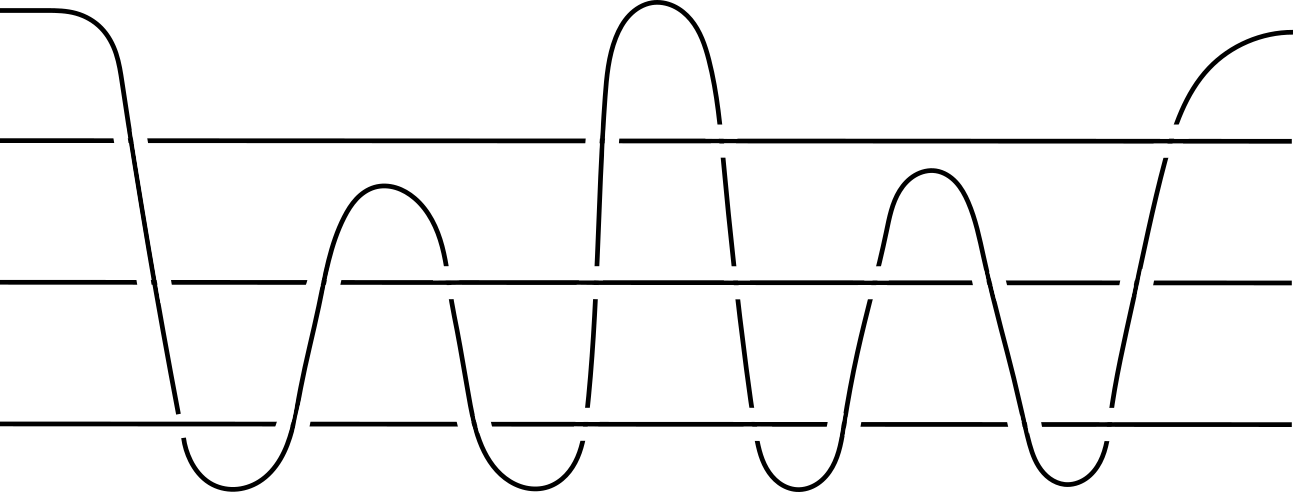
Long’s theorem says that is faithful on if it is faithful on any nontrivial noncentral normal subgroup (Long, 1986). Since is normal and noncentral, the proof reduces to the following target.
Brunnian target
If is faithful on , then is faithful on .
This reduction also supplies intersections. Nontrivial Brunnian four-braids are pseudo-Anosov, so their images of must intersect nontrivially (Whittlesey, 2000). Thus the Moody polynomial has crossings to measure.
Proper Point-Pushing Products
Point-pushing creates the braids used in the proof, but a push can also create artificial bigons between and the new red arc. Bigons are a problem because disk sequences should be computed only after and are in minimal position.
The paper isolates the local configurations that create such bigons:
- generalized bigons between the push loop and ,
- generalized -to- trigons,
- generalized rectangles.
These configurations are called bigon-forming polygons. A product of point-pushing braids is proper if can be represented in minimal position with and , no bigon-forming polygon occurs, and the initial and final pieces of do not undo the innermost disk around the pushed point.
Proper products preserve minimal position
If is a proper product, then and are in minimal position.
The definition is technical, but its purpose is simple: it ensures that a disk sequence after a push is a genuine minimal-position disk sequence rather than an artifact of unreduced bigons.
Four-Strand Disk Analysis
In , sign behavior is no longer determined only by the number of punctures in a disk. In full generality, a disk in a four-strand disk sequence is sign-preserving exactly for
and sign-changing exactly for
The parity condition is therefore not automatic.
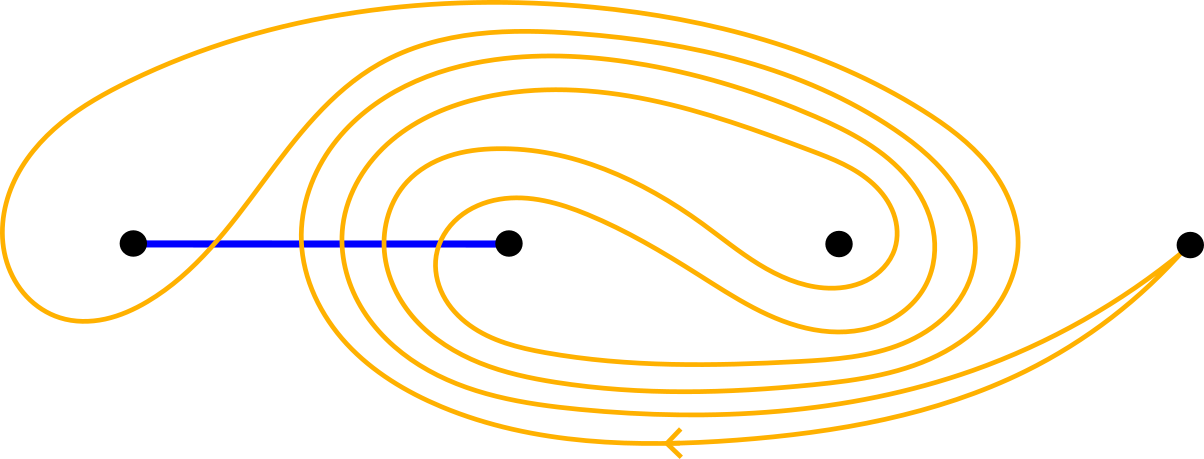
The authors choose the specific push-map shown in Figure 3. If a point-pushing braid has a proper product factorization
then the disk sequence becomes much more constrained.
| Behavior | Possible puncture sets after the restriction |
|---|---|
| sign-preserving | |
| sign-changing | , , , |
Figure 4 gives the finite geometric list behind this table.
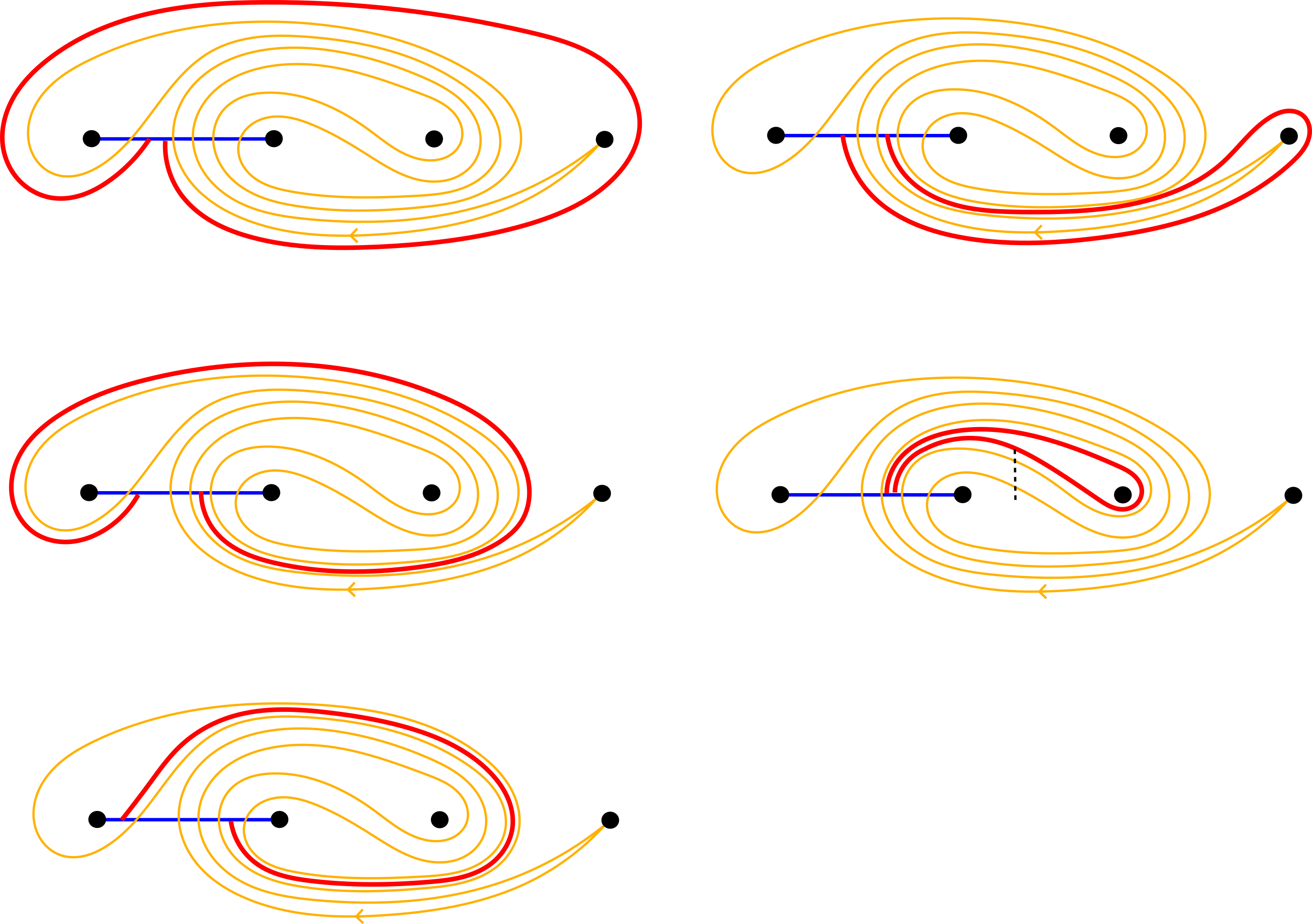
The four-strand problem is thus compressed into one exceptional disk type:
This disk is sign-changing but has even cardinality, so it violates the parity condition.
Five-Strand Stabilization Test
To repair the exceptional disk type, embed
by adding a fifth puncture . If
is a proper product in , the authors construct a push-map
such that both and satisfy the parity condition.
Figure 5 shows the construction. The point is chosen inside the innermost bad four-puncture disk. A path goes from to without crossing the red arc. A return path exits through the red side of each bad four-puncture disk and then returns to . The loop
pushes so that every bad four-puncture disk becomes a five-puncture disk.
The exceptional type changes as follows:
A five-puncture disk is sign-changing and has odd cardinality, so it satisfies the parity condition.
The loop is also chosen so that
Since both resulting Moody polynomials have no cancellations, this inequality of intersection counts forces
The Moody obstruction gives
By stabilization of kernel elements, this implies
Stabilization as a Testing Device
The five-strand step should not be read as an appeal to faithfulness in , which is false. It is a testing device. If a four-strand braid were in , then its stabilization would lie in . In that case the strengthened Moody obstruction would force
for every five-strand test braid .
The constructed violates exactly this equality. The role of the fifth puncture is to repair the one disk type where the four-strand parity argument fails. After that repair, both Moody polynomials have no cancellations, and the inequality of geometric intersection numbers becomes an inequality of Laurent polynomials. Thus the contradiction occurs inside , but the contradicted hypothesis is the original assumption .
Completion of the Proof
Let be a nontrivial element of . Since kernel membership is invariant under conjugation, it is enough to rule out the Burau kernel for a convenient conjugate of . The point-pushing group is free, and the proof chooses a conjugate whose freely reduced word does not cancel against the fixed final factor . After this conjugation, one obtains a proper product factorization
The five-strand stabilization test applies, so . Hence is faithful on , and Long’s normal-subgroup reduction upgrades this to all of .
Main theorem
The Burau representation
is faithful.
The Jones braid group representation contains the reduced Burau representation as a summand, so the theorem also implies faithfulness of the Jones representation for (Jones, 1987; Bharathram, Birman & Brendle, 2026).
Remaining Problems
The faithfulness problem is now settled, but two structural questions remain open:
- Describe the kernel of explicitly for .
- Characterize the image of the Burau representation inside .
The new paper is therefore not only a four-strand faithfulness proof. It also gives a disk-sequence method for detecting when apparent cancellation in a braid representation is geometrically impossible.
See Also
- on nonadditivity of unknotting number: Another low-dimensional topology result proved through an explicit geometric certificate.
- on self-avoiding walks and the honeycomb connective constant: Another example where local planar cancellations are converted into a global algebraic obstruction.
- on the lower bound of Ramsey number: Shares the theme of reducing a global existence question to a carefully engineered combinatorial certificate.