Overview
Alpöge (Alpöge, 2026) constructs a compact connected complex manifold of dimension three together with a surjective holomorphic map whose fibres over the complement of three points are complex tori of dimension two. The three special fibres are filled in by three classical surgeries. At the cusp the filling is a Mumford-style toroidal degeneration: a quotient of an infinite smooth toric threefold built on the -triangulation of the plane, whose central fibre is a degree-six del Pezzo surface with the opposite sides of its anticanonical hexagon identified — a reduced, irreducible, non-normal normal-crossings surface with . At the orbifold points of orders the fillings are Kodaira logarithmic transforms of multiplicities , with smooth bielliptic reductions . The family over the punctured sphere is entirely explicit: a period matrix written in three functions on the upper half-plane, equivariant under the triangle group , whose local monodromies have orders and whose monodromy at the cusp is unipotent with square-zero logarithm.
The gluing is controlled by three integers recording the twist data, and the fundamental group turns out to be
the same formula as the order of of the Seifert fibred space over (Orlik, 1972). The choice gives and , so is a homotopy six-sphere, homeomorphic to by Smale’s generalized Poincaré theorem (Smale, 1961) and diffeomorphic to it because (Kervaire & Milnor, 1963). The transported complex structure on is the one announced in the title of the manuscript.
The manifold is far from a bare topological example: it has algebraic dimension with the algebraic reduction, Hodge numbers , , a Frölicher spectral sequence that fails to degenerate at , non-torsion canonical bundle , Chern numbers , , and . The existence of contradicts a published theorem — Campana, Demailly and Peternell’s result (Campana, Demailly & Peternell, 2020) that a compact complex threefold homeomorphic to has algebraic dimension — and the last section of the manuscript locates the step at which the two accounts diverge: the central fibre is non-normal, and for every holomorphic line bundle , which is precisely the vanishing hypothesis that the published proof assumes away.
Preprint status and the stakes
The manuscript circulates only as a PDF at
alpo.ge/s6.pdf(August 2026). It has not been posted to arXiv, has no peer-reviewed version, and has not been independently verified; the circulated version carries no author line or acknowledgements, and public reporting describes it as produced with the assistance of the Claude AI system. If correct, it settles the Hopf problem — whether admits an integrable complex structure, open since 1948 — in the affirmative by explicit construction, and it does so while contradicting a published theorem (Campana, Demailly & Peternell, 2020, p.C or. 2.3), a step the manuscript itself flags and devotes its §10 to. Both features demand scrutiny. The history of the problem is littered with claimed resolutions that did not survive it: Atiyah’s 2016 nonexistence argument (Atiyah, 2016) was not accepted by the community, and Etesi’s 2015 construction (Etesi, 2015) has likewise not been generally accepted. A correct counterexample to a published theorem must additionally explain exactly which step of the printed proof fails, and the manuscript’s §10 attempts precisely that. These notes follow the manuscript’s structure and notation (the setup block, the matrices , the twist data) and verify by machine every identity that is checkable by machine — the monodromy linear algebra, the Smith normal forms, the twist integers, the Seifert-style fundamental group formula — as recorded in the numerical section. The topological recognition step (§8 of the manuscript) is classical and uses no computation; the genuinely new analytic input, the existence theorem for the period functions (Theorem 3.4), is proved by hand in the manuscript and is not machine-checkable in this form.
🏷️ Preliminaries
Almost complex and complex structures. An almost complex structure on a real manifold is an endomorphism with ; it makes every tangent space a complex vector space. A complex structure is an atlas of charts with holomorphic transition maps, and it induces an almost complex structure by multiplication by in chart coordinates. The converse is controlled by the Nijenhuis tensor
which vanishes if and only if comes from a complex structure (Newlander–Nirenberg); an almost complex structure with is called integrable. The question at hand is whether admits some integrable — not whether the octonionic one is integrable (it is not).
Algebraic dimension and the Néron–Severi group. For a compact complex space , write for its field of meromorphic functions and for its algebraic dimension. A compact complex torus has a canonical identification ; the Néron–Severi group consists of classes that are the first Chern class of a holomorphic line bundle, equivalently (Appell–Humbert) that carry a Hermitian form with on ; see (Birkenhake & Lange, 2004, p.C h. 2). A 2-torus has iff it is an abelian surface ( positive definite for some ), iff some satisfies with (an elliptic fibration), and otherwise — the fibration given by the algebraic reduction maps onto a curve and pulls the curve’s polarization back to .
The three classical ingredients. (i) The del Pezzo surface , the blow-up of in three non-collinear points, carries an anticanonical cycle made of six -curves arranged in a hexagon. (ii) A bielliptic surface is a quotient of a product of elliptic curves by a finite group acting by translations on and nontrivially on with ; the classification lists seven types (Barth et al., 2004, v.5), among them the types and that appear below, and every bielliptic surface has and torsion canonical bundle. (iii) Kodaira’s logarithmic transform (Kodaira, 1964): on an elliptic fibration over a disc with monodromy a fixed elliptic curve , one removes a smooth fibre and reglues by an automorphism of order — the result has a multiple fibre of multiplicity and, for coprime multiplicities at several points, can change the fundamental group without changing the base (this is how the simply connected Dolgachev surfaces are made from rational elliptic surfaces (Dolgachev, 1981)). Mumford’s toroidal degeneration (Mumford, 1972; Ash et al., 2010) is the corresponding completion of a degenerating family of abelian varieties over a puncture with unipotent monodromy: a fan (here the -triangulation of the plane) produces a toric model whose central fibre is glued from toric surfaces.
Surgery on the 6-sphere. The endgame uses three classical results: a closed smooth simply connected -manifold with the homology of is a homotopy sphere (Hurewicz–Whitehead (Hatcher, 2002)); for a homotopy sphere is homeomorphic to (Smale (Smale, 1961)); and the oriented diffeomorphism classes of homotopy -spheres form the finite abelian group of Kervaire–Milnor, with (Kervaire & Milnor, 1963; Milnor, 1965). In dimension six, therefore, topology offers no obstructions whatsoever — which is exactly why all obstructions to a complex structure on must be complex-analytic.
🏷️ The Hopf Problem: History and Obstructions
Hopf asked in 1948 whether the six-dimensional sphere carries a complex structure (Hopf, 1948); the question and its history are surveyed in (Agricola et al., 2018). The octonions furnish an almost complex structure on : identify with the unit sphere in and let act by left multiplication by a unit imaginary octonion. This structure, going back to Kirchhoff in 1947, is not integrable — its Nijenhuis tensor is nowhere zero — as shown by Eckmann–Fröhlicher and Ehresmann–Libermann in 1951 (see (Agricola et al., 2018) for the attribution). Borel and Serre proved that the only spheres admitting any almost complex structure are and (Borel & Serre, 1953), so the question concerns exactly one dimension. A further subtlety makes the problem resistant to soft methods: the space of almost complex structures inducing a given orientation on is connected, so no homotopy-theoretic invariant can separate a hypothetical integrable structure from the octonionic one.
The one general structural theorem is due to LeBrun (LeBrun, 1987) (anticipated by Blanchard): no complex structure on is orthogonal with respect to the round metric, because such a structure would make Kähler, contradicting ; all known refinements use only this vanishing. The structure constructed in the manuscript is not produced from any metric and carries no a priori relation to the round one, so LeBrun’s theorem does not bear on it.
The deepest obstructions come from complex-analytic geometry rather than topology. Calabi and Eckmann had already exhibited compact complex threefolds with — , the Hopf threefolds , and their cousins (Calabi & Eckmann, 1953) — so vanishing second Betti number is compatible with rich complex geometry; what distinguishes among these is the Euler number . Campana, Demailly and Peternell proved that a compact complex threefold with and satisfies , and deduced that a compact complex threefold homeomorphic to has algebraic dimension (Campana, Demailly & Peternell, 1998). That proof rests on (Campana, Demailly & Peternell, 1998, p.L emma 1.5), which is incorrect as stated; the corrigendum (Campana, Demailly & Peternell, 2020) re-proves the results in two cases and keeps the conclusion for a complex . In the other direction, Huckleberry, Kebekus and Peternell analysed the complex geometry of a hypothetical structure on : such an is not almost homogeneous, , , , and (Huckleberry, Kebekus & Peternell, 2000); Lehn, Rollenske and Schinko obtained bounds on spaces of sections and wrote out the meromorphic-map case of the Campana–Demailly–Peternell argument in detail (Lehn, Rollenske & Schinko, 2018); and Angella computed the Hodge numbers a hypothetical structure would be forced to have (Angella, 2018). Every one of these constraints is matched by the example below — the manuscript displays the comparison explicitly in its Remark 1.2, and this matching is the first test the construction passes.
🏷️ The Strategy in One Paragraph
Build a compact complex threefold fibred over whose smooth fibres are complex 2-tori, and arrange that the fibre data kill all topology except that of . The two classical mechanisms — Kodaira’s logarithmic transform and Mumford’s toroidal degeneration — are used simultaneously, over a base with exactly three critical points, for a representation of the triangle group whose local monodromies have orders . Three choices carry the whole construction: the rank-four lattice representation (two matrices of orders with unipotent product inverse), the period functions satisfying prescribed transformation laws (one free constant ), and the three twist integers . The fundamental group then collapses to a single cyclic group with — the Seifert formula of the fibration of — and the twist choice makes simply connected with the homology of . The Euler number is carried entirely by the singular fibre at the cusp: , all other fibres having Euler number — as the twelve nodal fibres carry the of a rational elliptic surface.
Two structural observations make the design possible, and both are forced. First, the family carries no polarization: the unique monodromy-invariant alternating form has the indefinite signature against the unipotent monodromy, so the very general fibre has algebraic dimension while the total space has . The Campana–Demailly–Peternell obstruction was designed exactly for this regime, and the manuscript must therefore confront it — the escape is through the non-normality of , the one feature of the central fibre their argument’s reduction assumes away. Second, the two rotation senses of the triangle group are coupled: the base has a single cusp, so the parabolic element of is determined up to conjugacy, and this forces to rotate in the same direction — which in turn fixes the relative sign of and in , and hence fixes the answer.
🏷️ Lattice and Monodromy Data
The entire construction hangs on a single piece of linear algebra over , and the manuscript fixes it first. Let with ordered basis , and let carry the dual basis ; matrices act on columns, and the columns of a matrix are the images of the basis vectors. Evaluation at is the functional
The monodromy matrices
In the basis set
that is,
These two matrices have exact orders and : one computes , , and (Lemma 2.2 of the manuscript). The product is with
so and
The dual picture on uses the contragredient
the unique element with for all — in the dual basis , , are the transposes of , , :
so , , and
The three distinguished sublattices
Three sublattices of will do the whole job. First,
and induces on a map
whose matrix in the identifications and is
in particular . This unimodularity is what later makes the toric filling have an irreducible central fibre containing a single copy of ; for the same construction would produce pieces (Remark 2.9). Second, the fixed lattices
where
are saturated, and . The twist vectors of the construction are
so that with one has
Third, the invariant alternating form: the -invariant alternating forms on form the infinite cyclic group generated by with
and vanishing on the remaining pairs of basis vectors (Lemma 2.8). The associated symmetric form descends to , where in the basis given by the classes of its Gram matrix is
nondegenerate of signature and discriminant . The point of this form is comparative: for a one-parameter degeneration of polarized abelian varieties with unipotent monodromy and polarization , the form on is definite (Clemens, Mumford); the pair has signature . This is the first indication that the family to be built has no polarization — the manuscript returns to it in Remark 3.23, and indeed the fibres carry no monodromy-compatible polarization, and none is used anywhere.
🏷️ The Orbifold Base and the Period Functions
The base of the fibration is the projective line with affine coordinate and three distinguished points: , , and the cusp with coordinate ; write and , . The relevant symmetry group is the (3,4,∞) triangle group
which is not the modular group: is a quotient of , and the modular parameter enters only through the orbifold morphism given by . By Poincaré’s theorem there is a copy of the upper half-plane, a Fuchsian group and a holomorphic surjection with a local biholomorphism off , of local degree over , and deck group (Proposition 2.11; for the Fuchsian group machinery see (Beardon, 1983)). The stabilisers are generated by fixing , with
and is parabolic, fixing a cusp whose stabiliser is exactly . A small -invariant cusp neighbourhood is squeezed between two horodiscs at and satisfies .
The two rotation senses are coupled
The fact that and rotate in the same sense — and , both clockwise — is not a convention: it is forced by the requirement that be parabolic. In the free product , the element is cyclically reduced of syllable length , and this is a conjugacy invariant; an element of infinite order is conjugate to a cyclically reduced word of even length , whose -th power () has cyclically reduced length — so is not a proper power and the cusp stabiliser is exactly . The mixed assignment in the reflection-group notation of the proof would make conjugate to , cyclically reduced of length but not a cyclic permutation of or of — hence not parabolic. The sign coupling propagates through the entire construction: it is exactly why the relation of the fundamental-group section holds with the same sign for , and hence why the relative sign of and in the fundamental-group formula is fixed once and for all (Lemma 7.16 of the manuscript, the “Sign Lemma”).
The analytic heart of the construction is the following existence theorem for an equivariant period map. All three functions are explicit solutions of elementary functional equations — no transcendental input beyond the modular -function enters, and the proof goes by the lifting criterion for followed by two torsor problems.
Theorem 3.4 (the period functions)
There exist holomorphic functions (the upper half-plane), such that:
and
with bounded on the cusp neighbourhood (so that descends across ), and
with bounded on (so that descends across ), and finally
The function is unique; is unique; is determined up to one additive constant , and is chosen so that holds. Then is a lattice in for every , including .
Two remarks unpack the statement. The function is the elliptic modular parameter of the orbifold morphism: it lifts against , and the three equivariance laws follow by rigidity — the order of is forced to be , and the parabolicity of forces to be conjugate to . The values at the elliptic points are compatible with the laws: , , and consequently the quadratic identities
which make the inhomogeneous terms of vanish at respectively — this is what makes prescribing at the elliptic points and extending by along words in well defined. The functions and are obtained as solutions of torsor problems over sheaves on the base (an -torsor for with , then an affine torsor for ), and the condition — the one genuine choice in the whole construction — is what makes a full lattice at every . Note that is -invariant, extends continuously across , and tends to at the cusp, so any with sufficiently negative works.
🏷️ The Family of Tori over the Punctured Sphere
Out of the period functions one forms the period matrix
whose columns are the images of in ; its rows, read in ,
span the space of holomorphic -forms of the fibre to come. The condition of Theorem 3.4 is exactly the nondegeneracy that makes a lattice of full rank in : for the block , the columns are -independent.
On let act by
giving the family of complex 2-tori, with a holomorphic zero section. For the equivariance
where is the (unique) invertible matrix — the right block of — lets act on by fibrewise-linear biholomorphisms
and , so the cusp monodromy acts on the fibre by the identity (the translation enters later, through the gluing). Removing the elliptic fixed points, carries a free action, and the quotient
is a proper holomorphic submersion whose fibres are complex 2-tori marked by : under the marking of the fibre, the loops lifting to act by respectively — this is the monodromy representation with , . The very general fibre is not algebraic; this is made precise in the invariants section, where the Néron–Severi group is computed from the period matrix.
At the cusp the family simplifies. Write ; then on one has with holomorphic and nowhere zero on the full disc, and with the period matrix takes the toric form
in the bases of and of , where is holomorphic at and , . The independence of the regularity of from the nilpotent orbit theorem is worth noting: it comes from the two torsor problems of Theorem 3.4 (they still have local sections at the cusp — , resp. — so the extension across is obtained directly, without positivity of a polarization, which is precisely what is not available here). This form of is the bridge to the toric construction: the factor carries the monodromy, the factor is the bounded correction.
Why the family carries no polarization
The invariant form of the lattice section restricts to the Hodge filtration as the Hermitian form whose Gram matrix is
so is nondegenerate of signature for either sign of (Remark 3.23 of the manuscript). Positivity with respect to would force and to have the same strict sign near the cusp, while both and (with the signs making them bounded) are -invariant hence holomorphic in and vanishing at — so continuation along the same loop would shift and by two integers of the same sign; but , give the shifts and . Invariantly: the form is indefinite, so supports no polarized limit mixed Hodge structure. This absence of a polarization is not a defect of the example — it is the reason the example escapes the Campana–Demailly–Peternell theory, whose arguments run through line bundles on fibres, and it is what makes the very general fibre genuinely non-algebraic while the total space still has .
🏷️ The Filling at the Cusp: A Toric Quotient
The filling at is a quotient of an infinite smooth toric threefold, in the spirit of Mumford’s construction of degenerating abelian varieties (Mumford, 1972; Ash et al., 2010; Kempf et al., 1973). Let be the -triangulation of : vertices , triangles
cut out by the three pencils , , , with edge directions . In with points written , let be the fan of cones over the cells of the triangulation (plus the origin), and let be the associated toric variety — smooth and Hausdorff but not of finite type, since has infinitely many rays (Fulton, 1993). The character , written , is a global holomorphic function on with
where is the divisor of the ray and every ray has height , so is reduced. In the chart attached to a triangle with vertices , the coordinates dual to satisfy and . Each divisor is itself a smooth toric surface: its fan is the star of , the complete hexagonal fan, so
the degree-six del Pezzo surface whose anticanonical cycle is the hexagon of six -curves with . Three divisors meet in a point exactly when is a triangle of .
The deck action is built from the two pieces of the cusp period matrix. The toric automorphism induced by acts by
on the torus; since one has , and the induce all integral translations of the triangulation at height . The bounded correction enters through the twist , and for small, on
the maps
generate an action of by biholomorphisms preserving (Lemma 4.3). (The manuscript writes for this group throughout §4; the bar notation keeps the two lattices apart.)
Theorem 4.5 (the filling at the cusp)
For with and , where :
(a) the action on is free and properly discontinuous;
(b) is a connected Hausdorff complex 3-manifold, a holomorphic covering, and descends to a proper surjective holomorphic ;
(c) for the fibre is the compact complex 2-torus of the period family, where and has — via the identity ;
(d) is a reduced, connected, compact complex surface, and as divisors; locally on the map is , , or according as the point lies on one, two, or three local branches — so is a normal-crossings surface, smooth away from three double curves and with exactly two triple points ;
(e) is trivial: extends to a nowhere-vanishing holomorphic 3-form on and descends to .
The freeness argument is the point at which the boundedness of is used quantitatively: a fixed point of , , on the torus would give by taking of the fixed-point equation, while is orthogonal with and makes the left side nonzero. On freeness is combinatorial: moves the orbit to , and bounded cells are not translation-invariant. Properness uses the local finiteness of the triangulation and the unimodularity a second time.
The central fibre is read off the geometry of the triangulation modulo the lattice. The quotient of by the translations — all of — is a single copy of modulo the identifications of the hexagon’s sides. Because the edges of come in the three parallel classes , the six sides of the anticanonical hexagon of are glued in three opposite pairs, and the double locus of consists of three smooth rational curves, each passing through both triple points and otherwise pairwise disjoint. The Euler-number arithmetic is worth spelling out: , each of the three glued side-pairs contributes a rational double curve with , and the two triple points add back :
and this single non-normal fibre carries the entire Euler characteristic of the threefold — as the twelve nodal fibres carry the of a rational elliptic surface. (For the same quotient would give pieces of ; it is exactly the unimodularity that makes irreducible with normalisation a single .) Finally, since the charts are star-shaped about the origin of each (Corollary 4.8), and the deck group of the covering is , so
Why the central fibre must be non-normal
A smooth fibre of the toric model is a with Euler number ; the target threefold needs , and gluing opposite sides of the hexagon is exactly how a toric degeneration can lose Euler number. The price is non-normality — and that price, as §10 shows, is the entire escape route from the Campana–Demailly–Peternell theorem: their argument passes from a singular fibre to its normalisation, and at a non-normal fibre the differential of the fibration itself produces the section that the passage assumes away. The Euler number and the non-normality are the same feature seen twice.
🏷️ The Elliptic Fillings: Logarithmic Transforms
At the elliptic points the filling is Kodaira’s logarithmic transform (Kodaira, 1964), the standard device for changing the fundamental group of an elliptic fibration without changing the base; the present construction is its analogue one dimension up, with 2-tori in place of elliptic curves — just as the Dolgachev surface, obtained from a rational elliptic surface by logarithmic transformations of coprime multiplicities, is simply connected (Dolgachev, 1981).
Fix . Let be a -invariant disc with Cayley coordinate , so that , , and for a coordinate on centred at . Over the family restricts to with central fibre , and the deck transformation lifts fibrewise-linearly to
generating the free -action whose quotient is :
The logarithmic transform replaces by its translate. For put
which in the flat coordinates of reads
Since , iterating gives , so is the translation by — the identity of — and the order is exactly because covers . Freeness is governed by the fixed-point criterion for all : with the fixed lattices , , and , , writing (resp. ) gives , , , and
The twist vectors , satisfy these: , .
Theorem 5.4 (the fillings at )
Let with if , resp. odd if . Then:
(i) generates a group acting freely and holomorphically on ;
(ii) is a complex threefold, descends to a proper surjective holomorphic , and
a smooth compact complex surface with ;
(iii) is a bielliptic surface (Barth et al., 2004, v.5) with
torsion free — of Bagnera–de Franchis type for and for — and both and are torsion in of order exactly ;
(iv) the logarithmic section is a well-defined holomorphic section of over , the fibrewise translation by it conjugates to ,
and descends to a biholomorphism over .
The surface is the quotient of the abelian surface by a cyclic group whose generator has nontrivial linear part — has eigenvalues with for , and for — so the reduction is bielliptic; is isogenous to a product of two elliptic curves because and are the two complex lines , both defined over . The torsion orders follow from the flat-bundle description: is the character line bundle with character , a primitive -th root of unity, and has character ; both have order exactly , and a line bundle on is trivial if and only if . The type refinement uses the classification list of bielliptic surfaces: order of forces of type , and order with torsion-free forces of type .
Two remarks make the surgery flexible. First, depends on only modulo (translating by conjugates to ), whereas the regluing map depends on itself — composing with translation by the single-valued section ; this dependence is exactly what the fundamental-group computation exploits, and it is why the fundamental group sees the integers rather than the vectors. Second, the theorem holds for every admissible with the same global family , the surgery taking place only over the disc : as and with and , the integer realises every admissible residue class. For the manuscript takes , , so ; the comparison threefold with has and is used throughout §7 as a control.
🏷️ Gluing and the Fundamental Group
The compact threefold is assembled from the four pieces along collars by fibrewise-preserving maps, regluing by translations by local sections: with from Theorem 4.5 (any small ), the from Theorem 5.4 (any small discs), and the tautological identifications over the annuli — the toric gluing and the transforms of Theorem 5.4(iv) —
and is induced by the projections. The result is independent, up to biholomorphism over , of all auxiliary choices (radii, discs, branches of logarithm); the only genuine parameters are the twist data (Theorem 6.2).
Theorem 6.2 (the compact threefold)
is a connected compact Hausdorff complex manifold of dimension , and is surjective holomorphic with connected fibres. Over the map is a proper submersion with fibres complex 2-tori; is a reduced, irreducible normal-crossings divisor; and with the bielliptic surface of Theorem 5.4.
The topology of is computed from the same data by van Kampen. Write with the clockwise meridians of and the meridian of the puncture . The holomorphic zero section of splits the fibre sequence, so
where is the zero-section lift of and the action is the monodromy. Three facts determine the amalgamation, and each is computed rather than asserted.
At . Over the punctured disc the quotient description shows that the zero-section lift of the -fold clockwise meridian ends at the deck generator: the zero section of is -invariant precisely because (the drift computed in Lemma 6.5(ii) is in , for both ), and no further fibre translation enters. Hence the filling imposes
and the relative sign of and is fixed by the Sign Lemma — the rotation senses of are coupled through .
At . The toric meridian differs from by a fibre translation, with unique, and one sets (well defined since vanishes on ). For the tautological gluing , i.e. : the zero section over the punctured disc corresponds under the toric description to the closed disc through , whose boundary circle over is exactly the toric meridian. A general fibrewise affine regluing at shifts and realises every ; altering any gluing by a fibrewise translation changes by (with ), hence changes by .
The collapsed directions. Attaching kills the classes in (they bound the discs through the corresponding divisors of the toric model), and the normal closure of under is all of (since ). The only lattice class surviving is the image of , which is central because is -invariant.
Theorem 7.17 (the fundamental group)
Let be admissible, , and as above. Then
this group is abelian, and
with ; in particular . For one has and ; for the comparison threefold with one has and .
The proof is a two-line computation once the presentation is in hand. From the group is generated by the commuting with relations and , i.e. with relation matrix
and the first elementary divisor is , so the quotient is cyclic of order . The congruence with and (admissibility) gives — the admissibility conditions of the logarithmic transforms are exactly what makes the fundamental group never divisible by : it can be trivial, or , but never .
The Seifert reading
The formula is the order of of the Seifert fibred space over with , : Orlik’s formula (Orlik, 1972), evaluated at and (the sign coming from the convention ), with Seifert invariants , and obstruction . For the value is and the space in question is with the circle action , whose orbit space is . Heuristically the twist condition says: glue so that the coinvariant circle of the fibres traces out the Seifert fibration of the three-sphere over the base. The body of the paper does not use this reading — it is the reason the formula looks familiar, not an input to the proof.
🏷️ Integral Homology
The homology is computed twice: once by a Mayer–Vietoris argument that proceeds through an explicit cell structure of the singular fibre (§7.2–7.6 of the manuscript), and once through the integral Leray spectral sequence of with nearby cycles at the toric fibre (§7.7 with Appendix B). The recognition of as uses only the second route; the two agree.
The Mayer–Vietoris route. Split , where is a thickening of the toric piece retracting onto and of the complement of a small disc around , itself covered by the two tubes over discs around retracting onto . The intersection is a torus bundle over the circle, and the kernel of is
where is the toric meridian (it bounds the disc in ) and is the 2-torus swept by the circle of the fibre along the toric meridian; the Wang sequence of gives for . In degree , the tubes contribute generated by (the common image of ) with relations , , and the isomorphism sends to
recovering Theorem 7.17. In degree , Mayer–Vietoris for gives with ; of the two swept tori, generates (), while survives. The evaluation of the surviving class is the sweeping lemma (Lemma 7.21): for a free -action — here fibrewise translation by the monodromy-invariant vector , free on by admissibility — integration over the fibre and the slant product give with , contraction with . With for , and with , one gets , hence
so (Lemma 7.19). Degrees then follow by Poincaré duality and universal coefficients on the closed oriented 6-manifold : finite gives ,
and the Euler number localises, (every other fibre is a 2-torus or a bielliptic surface, of Euler number ), so
and .
The Leray route. The second computation runs the Leray spectral sequence for , using at only the specialisation statement injective with image — proved in Appendix B from the toric local models by nearby cycles, without the cell structure — and at the radial retraction onto . A general lemma for local systems on identifies with the coinvariants , compatibly with cup products, and the meridian relations of the fundamental-group section then yield and for admissible pairs with — in particular for (Propositions 7.26, 7.27). Universal coefficients and Poincaré duality give when , and the conclusion
is obtained without any appeal to the Mayer–Vietoris computation (Remark 7.24). In summary, for every admissible and every (Theorem 7.22):
The comparison threefold has all middle groups equal to ; the difference between a six-sphere and a -homology threefold is exactly one sign in the second twist vector.
🏷️ Recognition: is Diffeomorphic to
The recognition step is classical and completely soft — which is the point: the hard information (simple connectivity and the homology) was computed exactly, and the rest is sixty-year-old topology.
Theorem 8.1
is diffeomorphic to .
The chain is: is a closed smooth simply connected 6-manifold with . By the Hurewicz theorem applied inductively, for and ; a map representing a generator of is a homology isomorphism, hence a homotopy equivalence by the homology Whitehead theorem (Hatcher, 2002). Thus is a homotopy 6-sphere, and by Smale’s generalized Poincaré theorem in dimensions (Smale, 1961) it is homeomorphic to and is a twisted sphere. By the -cobordism theorem (Milnor, 1965), for the -cobordism classes of oriented homotopy -spheres coincide with their oriented diffeomorphism classes, and by Kervaire–Milnor these form the finite abelian group , with
(Kervaire & Milnor, 1963). Hence is diffeomorphic to . Two remarks are worth recording. The diffeomorphism — not merely the homeomorphism of Smale — is what is needed: transporting the complex structure of through any diffeomorphism yields an integrable almost complex structure on the standard smooth whose complex manifold is biholomorphic to (Remark 8.4). And the proof uses only and — the homology being computed twice in §7, once with and once without the cell decomposition of the singular fibre (Remark 8.3), so the recognition does not rest on any single potentially delicate cell computation.
🏷️ Complex-Analytic Invariants
A topological with a complex structure would be sharply constrained by the results of Huckleberry–Kebekus–Peternell and Lehn–Rollenske–Schinko cited in the history section; the manuscript computes all the invariants of and displays the match explicitly (Remark 1.2). The input is the period description of the smooth fibres alone — neither the topology section nor the Campana–Demailly–Peternell theorem enters the computation of the algebraic dimension.
The Néron–Severi groups of the fibres
Under the marking, for , with the pairing and . A class , written
lies in the Néron–Severi group if and only if (for a complex torus, and is of type exactly when this wedge vanishes; the type and pieces kill it). Expanding against , gives
with the holomorphic function on (Lemma 9.2)
The five coefficient functions are linearly independent over (Lemma 9.3): evaluating a hypothetical relation at and subtracting uses to eliminate ; the remaining relation is then pushed through , where , and the bookkeeping forces (the final steps use only , ). Consequently if and only if
i.e. if and only if for the class
Theorem 9.1 (invariants of )
(i) , , is the algebraic reduction of , and the very general fibre of has algebraic dimension ;
(ii) , , ; hence , ;
(iii) and ; in particular is not a torsion line bundle;
(iv) in ; the Chern numbers are , , and , , ;
(v) and , acting fibrewise, with fixed locus one of the three double curves of (a smooth rational curve through both triple points) and normal weights ;
(vi) for , i.e. ; together with (ii), (iv) and Serre duality this determines every Hodge number in terms of the single integer : and for , .
For (i), note first that is genuinely a -class on every fibre: — this is the Lagrangian relation of the period matrix. Its self-intersection and its Hermitian form are computed from the period matrix: , so
and the Hermitian form (the unique one with on ) has Gram matrix with
so is nondegenerate of signature on every fibre (Lemma 9.4; at , , one checks and ). Since is a holomorphic function vanishing only on a discrete set for each , the set is countable, and the very general fibre has . Now a complex 2-torus with would carry a class with and positive definite (the pullback of the ample class of its algebraic reduction, which is a smooth curve since ; the reduction map is a surjective homomorphism to an elliptic curve with connected kernel) — but the only classes present are with and indefinite of signature , which excludes as well. Hence for the very general fibre, and every meromorphic function on is constant along it; since has connected fibres, is algebraically closed in , and
with the algebraic reduction. The manuscript gives a second proof of by exclusion: because embeds ; because a Moishezon threefold has while ; and , since a meromorphic map from to a curve that is not holomorphic would force by (Campana, Demailly & Peternell, 2020) (as written out in (Lehn, Rollenske & Schinko, 2018)), contradicting .
The remaining invariants are direct-image and Chern-class computations. The Frölicher spectral sequence of does not degenerate at , since — the manifold’s Hodge theory is visibly non-Kähler, as it must be for a manifold with . The exponential sequence, with , gives , so every line bundle on is topologically trivial — the single complex parameter of line bundles is invisible to topology, which is exactly what makes the direct-image computations of §10 decisive. The canonical bundle identity combines with (from ) to give , whose space of sections vanishes for by , while the trivial bundle has sections: is not torsion. The generating vector field of the -action is the vertical field determined by the monodromy-invariant vector of the period lattice — the unique circle direction of the fibres that survives all monodromy — and the fixed locus of the action, a single double curve of , is of one of the two shapes permitted by (Huckleberry, Kebekus & Peternell, 2000). Every one of the constraints listed in the history section is thus matched, item by item, in Remark 1.2 of the manuscript.
🏷️ The Conflict with Campana–Demailly–Peternell
The construction is incompatible with a published theorem, and the manuscript confronts this head-on: its §1.2 states the contradiction and its §10 locates the step at which the two accounts diverge. The published chain is as follows. In (Campana, Demailly & Peternell, 1998), Campana, Demailly and Peternell proved that a compact complex threefold with and has , and deduced that a compact complex threefold homeomorphic to has algebraic dimension . That proof rests on (Campana, Demailly & Peternell, 1998, p.L emma 1.5), which is incorrect as stated; the corrigendum (Campana, Demailly & Peternell, 2020) says so and re-proves the results in two cases. Theorem 2.1 of the corrigendum treats the case in which there exists a non-constant meromorphic map which is not holomorphic (written out in detail in (Lehn, Rollenske & Schinko, 2018)); Theorem 2.2 treats the case , with holomorphic algebraic reduction , concluding (a) for and generic , (b) , and (c) ; together these give (Campana, Demailly & Peternell, 2020, p.C or. 2.3): if is homeomorphic to then .
The manifold of the Main Theorem has , , holomorphic algebraic reduction , and , so conclusion (c) fails; so does conclusion (b), since and give, by Riemann–Roch, for every . It therefore contradicts (Campana, Demailly & Peternell, 2020) and Cor. 2.3, as well as Lemma 4.2 and its downstream statements, whose printed proofs presuppose trivial monodromy. It does not contradict Thm. 2.1 or (Lehn, Rollenske & Schinko, 2018), whose hypothesis is the existence of some non-constant non-holomorphic meromorphic map — and no such map exists on : by , every non-constant meromorphic map is of the form with rational, hence holomorphic.
Theorem 10.5 (where the published argument fails)
Let and be as in the Main Theorem. Then:
(a) for every one has and hence ; in particular hypothesis (1) of (Campana, Demailly & Peternell, 2020) is satisfied for no ;
(b) for every the restriction to the scheme-theoretic fibre is injective; under , , the sets are countable for all and discrete for ;
(c) for every with , a fixed point — that is, for general — one has .
The mechanism of (a) is the non-normality of , and the manuscript isolates it precisely. By (X1)–(X3), and for all , so for every , where is the normalisation. Since is a divisor in , it is Cohen–Macaulay with dualising sheaf , and Serre–Grothendieck duality on compact complex spaces gives
Now , for trivialising , vanishes on the double locus — the differential of the fibration itself kills the directions normal to the base along the two local branches — and therefore descends to a section of supported exactly at the non-normal locus of : the reduction of (Campana, Demailly & Peternell, 2020, p.692) to on a normal fibre would have no analogue here, since the passage through the normalisation assumes away precisely the section that exists. Hence for every , and by cohomology and base change in top degree (the fibre over is the reduced scheme-theoretic fibre) . The vanishing of this second direct image is the hypothesis under which (Campana, Demailly & Peternell, 2020) is invoked in the proof of Thm. 2.2; for it fails, for every , and so the proof of Thm. 2.2 does not cover . Separately, the count of in (Campana, Demailly & Peternell, 2020, p.L emma 4.2) (after (Campana, Demailly & Peternell, 1998, p.L emma 3.2)) assumes trivial monodromy, whereas the monodromy representation here is non-trivial; §10 shows that this point is repairable for , while the failure of the reduction at the non-normal fibre is decisive. The two statements cannot both be correct — and for that reason, the manuscript concludes, the construction is given with every matrix, chart and identification explicit.
📊 Numerical Verification
Throughout this section, denotes the integer for which (Theorem 7.17); it is the determinant of the relation matrix of the fundamental-group presentation. The script verify_s6_alpoege.py (in codes/2026 Fall/) checks, in exact integer and symbolic arithmetic with SymPy, every statement of the manuscript that is a finite computation: the monodromy linear algebra of §2, the transformation laws of the period functions of §3, the twist data, the presentation matrix behind Theorem 7.17, and the homology of the bielliptic reductions. No floating point enters anywhere; every check below returns an exact assertion.
| Check | Content | Result |
|---|---|---|
| 1 | , , , (exact orders ) | exact, confirmed |
| 2 | ; ; , , ; | exact, confirmed |
| 3 | ; ; ; | exact, confirmed |
| 4 | ; on ; (unimodular) | exact, confirmed |
| 5 | , ; ; ; ; ; | exact, confirmed |
| 6 | Smith normal form of equals ; coinvariants detected by | exact, confirmed |
| 7 | invariant under ; , , — Gram matrix , signature | exact, confirmed |
| 8 | Möbius laws: and have orders and ; , so ; the inhomogeneous terms of vanish at the special values , : , | exact, confirmed |
| 9 | symbolically; ; symbolically, negative under , | exact, confirmed |
| 10 | Relation matrix : ; group of order ; comparison : | exact, confirmed |
| 11 | and , both torsion free (primitive relation vectors) | exact, confirmed |
| 12 | Eigenvalues of : , ; of : — the linear parts that make bielliptic | exact, confirmed |
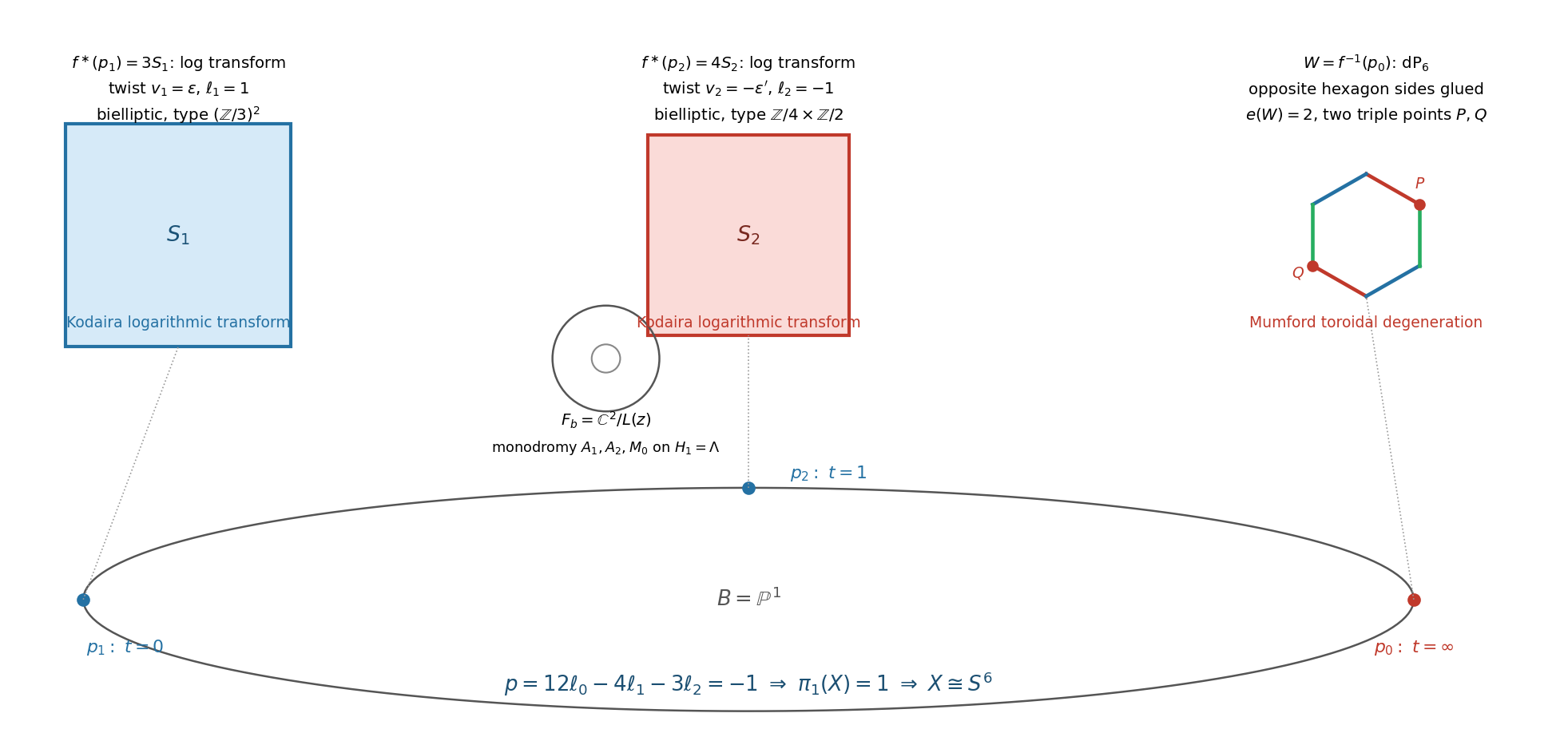
The figure records the structure the checks verify: the base with the three special points (the cusp, filled by the toroidal degeneration), (the elliptic points of orders , filled by logarithmic transforms with twist vectors ), the generic fibre a complex 2-torus with monodromy , the central fibre the glued hexagonal with and two triple points, and the bielliptic reductions with . The three integers are the only free data the topology sees, and makes — the Seifert fibration of in Orlik’s formula.
What the script deliberately does not check: the existence theorem for the period functions (Theorem 3.4), which is proved by hand through the lifting criterion for the -function and two torsor problems; the freeness and properness estimates of Theorem 4.5, whose only analytic input is the boundedness of ; and the direct-image and Chern-class computations of §9, which use base change and duality rather than finite algebra. Those are the analytic content of the manuscript and remain the parts on which independent verification must focus.
Links
- on a metric of positive sectional curvature on S2 x S2 — the other Hopf problem of the season: Brendle–Hung’s metric of positive sectional curvature on resolves the Hopf conjecture on product metrics by an explicit third-order perturbation of a Cheeger deformation. Both posts concern explicit constructions resolving Hopf’s questions, and both carry the same verification discipline: everything machine-checkable is checked, the single external computation is flagged.
- on min-max theory and the Willmore conjecture — Marques–Neves’s resolution of the Willmore conjecture is the archive’s other landmark in the interaction between geometric existence questions and hard topology; the recognition step of the present post (Hurewicz–Whitehead–Smale–Kervaire–Milnor) is the purely topological half of such an argument, used here with no variational component at all.