Overview
This post serves as a study note for the Ising model, a fundamental paradigm in statistical mechanics for understanding phase transitions and collective behavior in discrete systems. We cover the Hamiltonian formulation, symmetry breaking in the thermodynamic limit, Kramers-Wannier duality, and the transfer matrix method.
🏷️ Introduction
The Ising model was originally proposed to explain ferromagnetism. It consists of discrete variables called spins placed on a lattice. The system’s energy is defined by the Hamiltonian:
where interact strength determines ferromagnetic () or anti-ferromagnetic () behavior, and is an external magnetic field. The probability of a configuration is given by the Boltzmann distribution:
where is the Partition Function.
🏷️ Phase Transitions and Symmetry Breaking
A phase transition occurs when a system changes its collective state abruptly. In the Ising model, this manifests as Spontaneous Symmetry Breaking (SSB).
🏷️ The Mathematical Perspective: Non-commutativity of Limits
For any finite system () at , the Gibbs measure is unique and symmetric, meaning for all . Symmetry breaking only emerges in the thermodynamic limit (). The defining signature of SSB is the non-commutativity of limits for the magnetization :
Below , the inner limit produces a non-zero value even as . This implies that the free energy density is non-analytic, and the magnetization is discontinuous.
🏷️ Peierls Argument: The Energy-Entropy Tension
To prove that exists in 2D, we analyze the stability of an ordered state against the formation of “islands” of reversed spins. Consider a domain boundary of length . The energy cost scales as , while the entropy gain for a closed loop of length is approximately . The resulting free energy balance is:
For small , for all , meaning large-scale fluctuations are suppressed and the system remains ordered.
🏷️ Kramers-Wannier Duality
Kramers and Wannier discovered a deep symmetry relating the high-temperature and low-temperature regimes of the 2D Ising model.
🏷️ Primal and Dual Lattices
The duality maps a square lattice to a dual square lattice where nodes sit at the centers of the primal faces.
- At Low , the system is described by the alignment of spins.
- At High , the system is better described by the configuration of domain walls.
🏷️ The Duality Relation
The partition function at inverse temperature is related to the partition function at a dual temperature via:
If a unique phase transition exists, it occurs at the self-dual point where , yielding:
🏷️ Transfer Matrix Technique (1D Case)
For the 1D Ising model with spins and periodic boundary conditions, the partition function for is:
We define the Transfer Matrix :
The partition function simplifies to the trace of the -th power of :
where and . In the thermodynamic limit:
Because the free energy is analytic for all , no phase transition exists in 1D.
📊 Numerical Verification
Since the state space is , exact computation is impossible for large . Instead, we use Markov Chain Monte Carlo (MCMC) algorithms like Metropolis-Hastings (see content/codes/2023 Spring/ising_2d_simulation.py).
The simulation reveals the sharp transition at :
- : Large domains of aligned spins dominate. The system has long-range order.
- : Fractal-like clusters of all scales appear. The correlation length diverges.
- : Thermal noise destroys order, resulting in a disordered state.
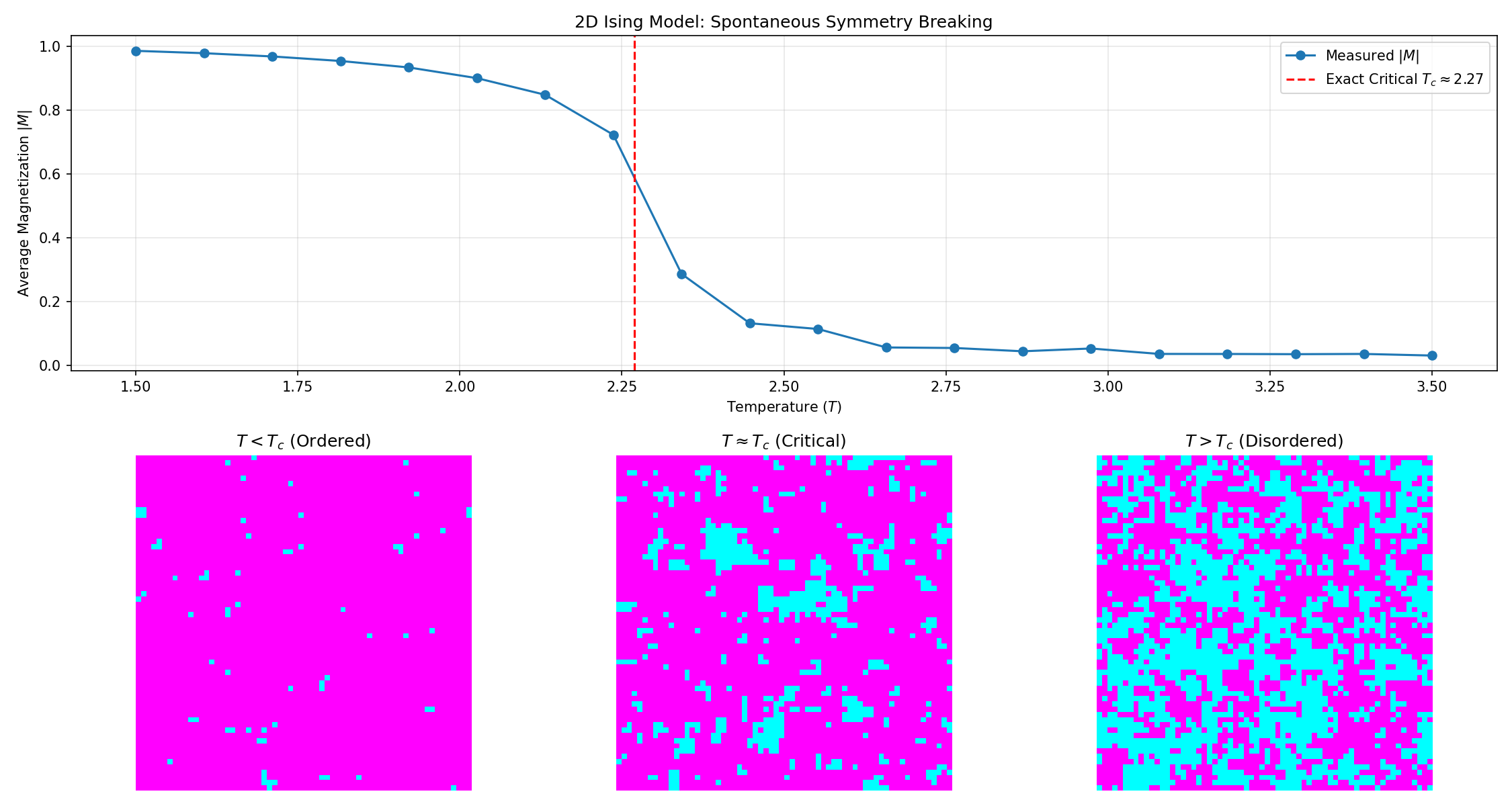
(Above: Magnetization curve and lattice configurations at different temperatures. Note the spontaneous symmetry breaking as drops below .)
🏷️ Metropolis Algorithm
- Duality: The 2D Ising model satisfies Kramers-Wannier Duality, allowing the exact calculation of .
- Mean Field Theory: An approximation that overestimates but provides qualitative insight.