Source and verification
This article explains family 331 of the October 6, 2026 OpenAI collection. Research conclusions are attributed to its manuscripts. The review covers statements, introductions, and selected proof mechanisms; it is not an independent verification of the complete proofs.
Overview
Family 331 studies a distinction between two kinds of asymptotic convexity. Opposite perturbations can force an average norm increase even when no equivalent norm forces a one-sided increase in every sufficiently far-out direction. Seven companions develop reflexive tree examples, midpoint-lens estimates, diamond distortion, exact moduli, and alternative constructions. They share a bounded-path obstruction but do not define one interchangeable space. (OpenAI, 2026) (OpenAI, 2026b) (OpenAI, 2026b) (OpenAI, 2026c) (OpenAI, 2026d) (OpenAI, 2026d) (OpenAI, 2026f)
🏷️ Preliminaries: removing finitely many directions
For an infinite-dimensional real Banach space with norm , let be its closed finite-codimensional subspaces. A useful interpretation is that finitely many continuous linear constraints are imposed on the perturbation.
For a unit center , a unit direction , and , define
The averaged midpoint and one-sided moduli are
The subspace is chosen after the center and before the direction. Positivity of the second modulus for every is asymptotic uniform convexity (AUC).
The historical definition of asymptotic midpoint uniform convexity (AMUC) uses the maximum of the two endpoint norms. Its positivity is equivalent to positivity of the averaged modulus used here. Indeed, intersect a proposed subspace with the kernel of a norming functional for . Both endpoint norms are then at least one, so the average excess is at least half the maximum excess.
AUC implies AMUC for a given norm. The difficult question is whether AMUC forces the existence of some equivalent AUC norm. The manuscripts credit Baudier’s earlier negative answer in general and distinguish their reflexive examples and quantitative refinements from that result.
🏷️ A reflexive segment-space example
For each , take the countably branching tree of words of length at most , keeping the trees disjoint. A segment is an interval along an ancestral chain. For finitely supported arrays on this forest, define
where the segments are pairwise disjoint. Let be the completion and with its dual norm.
Singleton segments give , while the triangle inequality gives . The choice of branching and the unbounded collection of finite heights is part of the construction.
Principal manuscript claim
The space is infinite-dimensional, separable, and reflexive, has no equivalent AUC norm, and satisfies
Every embedding of the depth- countably branching diamond into this normed space has distortion at least . (OpenAI, 2026a)
The full dual is not to be identified indiscriminately with coordinate spans for other forests. In particular, the infinite-height companion uses
the closed coordinate span for the infinite countably branching tree, as a separately specified space.
🏷️ Midpoint lenses and a sharper diamond bound
For a center and radius , the midpoint lens is the set of with . A finite coordinate set is ancestral if it contains every ancestor of its vertices. Write for coordinate restriction and .
The lens companion claims, in both and , that
The displacement may have a nonzero head. The same works for every displacement in the lens. (OpenAI, 2026g)
This estimate measures the full quadratic radius deficit. Its proof represents endpoint functionals by combinations of segment atoms. Opposite-sign segments meeting the same exit from the head create cancellation; splitting nested segments controls that cancellation by their unused test energy. Keeping coefficient error and unused energy in one budget gives the square-root bound.
A countably branching diamond starts from one edge and repeatedly replaces each edge by countably many two-edge paths. Give each new edge half its parent’s length. Distortion means
for every pair and some .
The infinitely many middle vertices supply separated displacements in a lens. Two finite-coordinate projections can be made arbitrarily close; the half-difference of the corresponding displacements stays in the lens and has essentially all its size in the tail. The lens bound therefore forces a squared-radius loss. Summing that loss over the levels gives the later companion’s stronger bound
for both and . (OpenAI, 2026b)
The and constants belong to different estimates. Normalizing the original graph edge to length one changes the scale , not distortion.
🏷️ Why no equivalent AUC norm exists
The recurring obstruction is a tree of uniformly bounded path vectors whose child increments are weakly null and have norms bounded below. A finite-codimensional constraint cannot eliminate all children: their distances to the constraint subspace tend to zero.
Suppose an equivalent norm lay between and . A positive one-sided asymptotic modulus at a fixed scale determined by would allow successive children to be chosen with a definite norm increase along the path. Equivalence keeps the original path bound finite, while arbitrarily long paths force growth beyond it.
For the segment model, root-path functionals have norm one and the child increments are unit coordinate functionals. This proves an obstruction to every equivalent AUC norm, which is stronger than merely finding a radius where the given norm’s one-sided modulus vanishes.
🏷️ Exact moduli in a Daugavet subspace of L¹
The Daugavet property is the identity for every rank-one bounded operator . The fourth companion considers an infinite-dimensional closed real subspace of a probability space whose unit ball is totally bounded for convergence in measure and whose inherited norm has this property.
It claims the exact formulas, at every unit center and hence globally,
It also constructs such an example using the Kadets–Werner enlargement scheme and proves that no equivalent AUC norm exists. (OpenAI, 2026c)
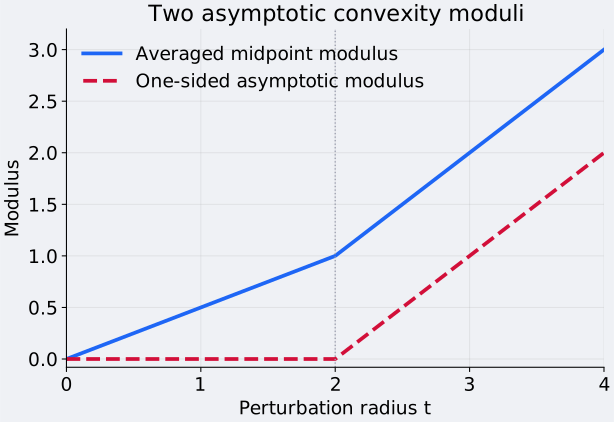
The exact curves claimed under the Daugavet and measure-precompactness hypotheses. The plot evaluates the displayed formulas; it is not numerical evidence for the hypotheses or proof.
The midpoint calculation starts from the scalar identity
After integration, midpoint gain is mass lying beyond a pointwise clip. Measure precompactness and finite sign tests control this mass uniformly on a finite-codimensional subspace. Daugavet weak-neighborhood geometry supplies almost diametral vectors for the matching upper bounds. The two hypotheses play distinct roles.
These exact curves are not formulas for the reflexive segment model.
🏷️ Bounded potentials and independent products
The fifth companion builds several tree-potential norms. A scalar coefficient family has potential constrained by , with additional square-sum budgets. The four initial completions have
and no equivalent AUC norms. Splitting a tail potential into two inward-directed parts preserves the interval constraint and combines quadratic budgets. Later path-cost and segment-cost constructions use different norms and constants; the paper does not identify them all. (OpenAI, 2026e)
The sixth instead takes independent positive multipliers with mean one and finite second moment along a tree:
Every nonconstant such law gives the claimed obstruction to AUC renorming: products have norm one and fresh child increments remain weakly null with positive norm. Positive midpoint estimates are proved for the exponential and squared-Gaussian laws, not for every admissible multiplier. For the exponential law one displayed bound is
where is a standard real Gaussian. (OpenAI, 2026d)
Conditioning on a finite ancestral tree leaves independent exit multipliers. Symmetrization controls the coefficient size, and a scalar tail estimate forces midpoint gain. This construction makes no general claim of reflexivity, the Daugavet property, or measure precompactness.
🏷️ Two recursive potentials
The final companion represents a vector as the difference of two nonnegative tree fields. Each field dominates the Euclidean norm of its children, and the least feasible pair makes one constraint tight at each node.
It distinguishes an infinite-tree root-sum space, a zero-root joining of finite-height components, and a joined space with a free root coordinate. The root-sum and joined norms have the claimed bound
All three fail AUC renormability; the zero-root and joined spaces are reflexive. The zero-root quantitative statement retains its head-support and tail hypotheses. (OpenAI, 2026f)
Averaging endpoint fields increases the center’s two fields by the same amount . For center fields , the quantity
dominates the sum of its child quantities. Iterating this energy inequality controls the tail by the root defect without multiplying a loss at every level. Alternative stopping and logarithmic arguments and a variable-exponent model supply further estimates with their own normalization.
🏷️ Key steps and proof outlines
Finite heads turn asymptotic questions into tail estimates
The basic order of quantifiers is important: for each unit vector , one may choose a finite-codimensional space depending on , but the final lower bound must hold for every unit vector in that space. In a coordinate construction, first approximate by a finite head and then require the perturbation to vanish on a larger head. A head–tail estimate uniform in that enlargement survives approximation and proves the asserted modulus.
For the finite-height segment space, the relevant dual geometry comes from families of disjoint segments. Pairing the two endpoint inequalities controls a tail that may carry a substantial part of the perturbation. This gives the square-root modulus rather than a merely qualitative strict inequality. The bounded branch sums and weakly null successor vectors separately obstruct any equivalent AUC norm: every finite-codimensional subspace contains successors arbitrarily closely, so an AUC gain would accumulate along arbitrarily long branches whose original norms remain bounded. Equivalence of norms makes those two conclusions incompatible. (OpenAI, 2026a)
Lens estimates need a joint budget for both endpoints
For a finite ancestral head , let discard its coordinates. The segment-space lens estimate starts with , where lies in the head, and concludes
The head of is unrestricted. Consequently, proving the estimate only for disjointly supported would leave a gap. The manuscript resolves this by representing the two endpoints with atomic segment data, aligning their coefficient descriptions, and charging both coefficient mismatch and endpoint slack to one common budget. Opposite-sign exits cancel when the representations are paired. The resulting quadratic bound measures only the tail, while allowing arbitrary changes inside the head. (OpenAI, 2026g)
For countably branching diamonds, infinitely many midpoint images have bounded finite-head projections. Two can therefore be selected with arbitrarily close projections. Their half-difference has a large tail by the lower Lipschitz bound, while the lens inequality bounds that tail by the available squared-radius slack. Repeating across levels spends a definite amount of squared distortion at every level. The claimed estimate comes from summing these losses, rather than multiplying a one-level distortion bound. The related tree-energy argument uses its own constants. (OpenAI, 2026b)
In real , clipping exposes mass forced outside the head
The scalar identity
turns the averaged midpoint expression into an integral of excess mass. For fixed and scale , clip a perturbation at height . In the Daugavet subspace, precompactness in measure of the unit ball and domination by the integrable envelope make the clipped family compact in . A finite collection of sign tests approximates its norm. Intersecting the kernels of those tests produces a finite-codimensional subspace where the clipped part satisfies . Hence the mass left above the clip contributes , explaining the coefficient .
The remaining mass gives the lower midpoint estimate. The Daugavet property supplies perturbations in suitable weak neighborhoods for the reverse estimate and for the one-sided modulus. The manuscript therefore obtains exact formulas, not just positivity: the averaged midpoint modulus is and the one-sided modulus is . The latter does not become positive at small scales, illustrating why averaged midpoint information cannot be substituted for AUC. (OpenAI, 2026c)
Potential constraints require a legal way to split tail tests
In the bounded-potential models, admissible tests satisfy constraints on ancestor sums . At a gate between head and tail, the old potential already occupies part of the allowed interval. Simply adding a tail test can violate the constraint.
The source splits the tail test into two inward-directed parts relative to the gate potential. The relative potential is bounded by two, and the split ensures that the combined tests remain admissible at every descendant. Their square budgets control the tail norm after pairing the two endpoints. This is the mechanism behind the reported bounds. Linear and quadratic path costs require separate budget calculations; the same formal tree picture does not identify their constants. (OpenAI, 2026e)
Independence supplies fresh randomness after a finite head
For the independent-product models, conditioning on the variables in a finite head leaves independent fresh multipliers at its exits. A tail vector can be decomposed into centered fresh terms and the remaining coefficient contribution. Symmetrization controls the coefficient size needed to detect a nontrivial tail. For exponential multipliers, explicit positive tail probabilities then force a positive midpoint gain; the squared-Gaussian case has a separate moment argument.
The hypotheses for failure of AUC renorming are broader than those used for positive midpoint estimates. Nonconstant positive mean-one multipliers with finite second moment provide the obstruction, whereas the manuscript proves the quantitative positive modulus for specified distributions. The proof does not license extending those estimates to every multiplier law. (OpenAI, 2026d)
Recursive slack must telescope without a loss at every depth
In the two-potential construction, feasible nonnegative fields dominate the Euclidean norm of their child values. At each node, a minimal feasible pair has at least one tight constraint. Averaging endpoint data adds a common nonnegative slack to the two fields. The useful energy is
If the constraint is tight, the square identity for and Hölder’s inequality control the sum of child energies by the parent energy; if the constraint is tight, exchange their roles. Summing over generations therefore telescopes at the root, without a multiplicative deterioration with tree height. This produces the cubic midpoint bound in the stated root models. Zero-root and joined constructions need their separate head–tail reductions; the variable-exponent and stopping alternatives use different energies. Together, these papers show several ways to convert local admissibility and slack into a uniform asymptotic estimate. (OpenAI, 2026f)
See Also
- Markov type and superreflexivity concerns uniform convex renorming; finite-codimensional asymptotic geometry is a different notion.
- Reflexive fixed points helps distinguish reflexivity from additional convexity conditions on a specified norm.
🏷️ Manuscripts and verification scope
- Asymptotic midpoint uniform convexity and unbounded diamond distortion in a reflexive tree space — pinned manuscript and companion source.
- Midpoint lenses in segment spaces — pinned manuscript and companion source.
- Distortion of countably branching diamonds from midpoint and tree energies — pinned manuscript and companion source.
- Exact asymptotic moduli in a Daugavet subspace of L1 — pinned manuscript and companion source.
- Midpoint convexity from bounded tree potentials and path costs — pinned manuscript and companion source.
- Independent products in real L1: asymptotic midpoint convexity without AUC renormings — pinned manuscript and companion source.
- Midpoint convexity from two recursive potentials — pinned manuscript and companion source.
The family scope page describes selected formalization coverage. Coverage is specified separately for all seven companions. In particular, the all-pairs diamond bound is listed as unconditional, while further graph deductions retain 22 companion assumptions. General-forest results retain their coordinate-span hypotheses; zero-root, variable-exponent, and other auxiliary estimates retain their support and tail assumptions. This is not blanket verification of every statement in the seven papers. No Lean build, axiom audit, or manuscript-to-formal-statement equivalence check was performed for these notes.
OpenAI collection provides prerequisites and the reading sequence; coverage register records completed and pending families.