Source and verification
This article explains family 158 of the October 6, 2026 OpenAI collection. Research conclusions are attributed to its manuscripts. The review covers statements, introductions, and selected proof mechanisms; it is not an independent verification of the complete proofs.
🏷️ The unit-distance graph
A proper coloring of the Euclidean plane assigns a color to every point so that points at distance exactly one receive different colors. The least number of colors is denoted . No measurability, continuity, or restriction on the shapes of color classes is part of this definition.
Although the vertices lie in the plane, this is not a planar graph problem. Straight segments representing unit-distance edges can cross. The four-color theorem for planar graphs therefore does not answer the question.
Manuscript claim
There is no proper five-coloring of the plane. Together with a seven-color construction, this gives . (OpenAI, 2026)
The statement leaves the choice between six and seven unresolved. It concerns arbitrary colorings, not merely measurable ones.
🏷️ A seven-color geometric benchmark
The upper bound can be understood through a regular hexagonal tiling of circumradius . Index its centers by integers , with center coordinates , and assign color modulo seven. For two identically colored centers, their index difference satisfies . Their squared separation is
Substituting shows that the positive integer is divisible by seven, so it is at least seven. Same-colored centers are therefore separated by at least . A hexagon has diameter , and the triangle inequality gives a distance of at least between points in distinct same-colored hexagons.
Taking gives
Thus no same-colored pair has distance one, either within a tile or between different tiles. Boundary points can be assigned to one incident hexagon; the strict inequalities persist. This construction explains why the new issue is a lower bound against five colors.
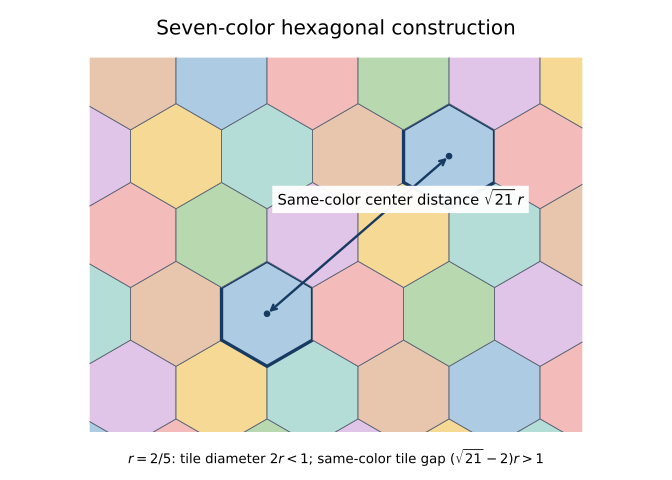
The diagram shows the upper construction only. The two outlined tiles have the same color; their center separation gives the strict lower bound on distances between the tiles.
🏷️ Weak measurable colorings
The proof introduces a weaker measurable object. Let be a measurable partition of the plane. Call it a weak coloring when, for every radius ,
Here is arc-length measure on the unit circle. The integrand is nonnegative, so it vanishes for almost every location-direction pair. Exceptional unit-distance pairs are allowed. Changing the color classes on a null set leaves the condition unchanged.
The manuscript’s transfer theorem equates existence of an arbitrary proper -coloring with existence of such a weak measurable -coloring. It does not identify arbitrary proper colorings with proper measurable colorings. The relaxation in the displayed integral is what makes the transfer possible.
In the forward direction, the source first averages color data on a countable algebraic plane to obtain an invariant random labeling. A spectral decomposition separates ordinary continuous translation characters from the remaining characters. Rotational invariance forces the latter part to have vanishing correlation under nonzero translations. Conditional expectation onto the continuous part then produces nonnegative measurable fields summing to one; choosing a positive label yields the weak coloring.
For the reverse direction, density points of the weak color classes cannot form a monochromatic unit-distance pair. Any prescribed finite unit-distance configuration can be translated so that all its vertices are density points, since the exceptional set is null. The resulting proper colorings of all finite configurations imply a coloring of the entire unit-distance graph. This last finite-to-infinite principle is used as an interface; no course in mathematical logic is needed for the geometric argument.
🏷️ Angular palettes and a topological obstruction
Once a weak five-coloring is available, the proof examines colors visible in angular directions around typical points. Weak limits and smoothing turn this information into probability vectors. Away from small exceptional disks, the relevant vectors have restricted supports, usually involving at most two labels. They can therefore be viewed in the graph formed by the vertices and edges of a five-label simplex.
The manuscript organizes exceptional centers into a locally finite set. Loops around these centers force cycles of length three, four, or five in the label graph. Each possibility is then confronted with Euclidean distance information.
A recurring geometric mechanism uses connected sets of points carrying prescribed labels around a common center. If the possible distances between two such connected sets include values below and above one, continuity forces a unit-distance pair. A monochromatic instance contradicts the palette restrictions. The three-, four-, and five-cycle cases require different arrangements: sector configurations, parity constraints, and finite angular words.
This is why averaging alone is insufficient. Averaging supplies a measurable object, but the lower bound still depends on the detailed geometric exclusion of every permitted cycle pattern. The manuscript includes finite geometric calculations within those exclusions; these notes have not independently executed their certificates.
🏷️ Finite witnesses and quantitative limits
If the claimed non-five-colorability holds, some finite unit-distance graph is already not five-colorable. This follows from the same finite-to-infinite coloring principle. It does not supply an explicit small graph from the introductory statement.
For any such finite witness , every five-color assignment has at least one monochromatic edge, giving a monochromatic-edge fraction at least . This elementary deduction is an existence statement about a positive bound. It should not be presented as an explicit numerical estimate until a particular witness and its edge count are supplied.
🏷️ Key steps and proof outlines
Density-one representatives turn weak exclusion into exact exclusion
The reverse transfer from a weak measurable coloring has an elementary but important proof. Suppose and , , are both density-one points of the same weak color class . For small , choose uniformly in and independently choose on a short positive-length circle arc with .
Density at gives . The law of is a mixture of translated uniform disk laws. It is supported in and has planar density at most , so
For sufficiently small , both points belong to with positive probability. Their distance is exactly one, and the joint parameter law is absolutely continuous with respect to location times angular measure. This contradicts the weak coloring integral, which forbids a positive measure of such pairs. Thus each color’s density-one set is exactly unit-independent. (OpenAI, 2026)
The density-one sets are disjoint and have conull union by differentiation. Any fixed finite unit-distance configuration can be translated into that union, because the allowed translation vectors form a finite intersection of conull sets. It inherits a proper coloring. Compactness of the product of finite color spaces then gives a coloring of the entire graph. This argument permits exceptional individual pairs in the original weak partition and removes them only after taking density-one representatives.
Positivity is necessary in the forward transfer
Starting from an arbitrary coloring, the source first constructs an invariant random labeling on a countable plane. The projection onto continuous translation spectral data must preserve nonnegativity and the sum-one condition. A generic orthogonal projection in need not preserve positivity; the manuscript identifies this particular projection as conditional expectation onto the sigma-algebra generated by continuous vectors.
For the projected label fields , one obtains and . The spectral decomposition and rotational argument supply vanishing same-label unit correlations after projection. Because the fields are nonnegative, a positive overlap cannot cancel against a negative contribution. Select, at each point, a label with positive field value using a fixed tie rule. The resulting measurable partition inherits weak unit exclusion. This is the required bridge from unrestricted colorings to a measurable object; it does not assert that every arbitrary coloring is itself measurably equivalent to a proper measurable coloring.
Palette topology must retain actual geometric constraints
After smoothing and removing small exceptional regions, restricted-support label vectors lie in the vertices and edges of the five-label simplex. Their loops can carry nontrivial three-, four-, or five-label cycles. The manuscript’s angular and transition arguments organize the exceptional centers locally finitely and force one of these cycle patterns. Each pattern then needs its own geometric exclusion.
The common geometric principle is a connected-distance test. If connected sets carry one prescribed label and the continuous distance function on takes values both below and above one, its image is connected and contains one. The resulting monochromatic unit pair contradicts the density-point or palette exclusion. The hypotheses matter: disconnected sets may jump between distance ranges, and merely knowing their diameters does not ensure the required cross-distance interval. The source’s sector and angular-word constructions supply connected sets and endpoint inequalities in the particular cycle cases.
Thus the proof requires three logically separate interfaces: spectral averaging with positivity, topological extraction of a restricted-label cycle, and exact Euclidean exclusion of every such cycle. The density-one argument above verifies the weak-to-proper transfer, but neither it nor the seven-color illustration proves the five-color obstruction. The finite geometric calculations in the last interface remain attributed source inputs rather than independently executed certificates here.
Strict inequalities make the seven-color benchmark robust
For comparison, the hexagonal upper construction needs no measurable transfer. With circumradius , each tile has diameter . Identically colored centers are separated by at least , so points in different same-colored tiles have distance at least . Both inequalities have strict slack, allowing every boundary point to be assigned to a single incident tile without creating a unit pair. This explains exactly what the diagram establishes: a valid seven-color upper bound for arbitrary points, including tile boundaries, while the lower-bound manuscript excludes five by the much deeper preceding interfaces.
See Also
- Planar distance fibers counts repeated distances and unit-distance pairs, rather than coloring the entire plane.
- Euclidean Ramsey configurations concerns monochromatic congruent copies in sufficiently high dimension, with the original scale retained.
🏷️ Manuscripts and verification scope
- The Euclidean plane is not five-colorable — pinned manuscript and companion source.
The family scope page describes selected formalization coverage. The page selects non-five-colorability for arbitrary colorings and a seven-color upper construction including boundary points. No Lean build, axiom audit, or manuscript-to-formal-statement equivalence check was performed for these notes.
OpenAI collection provides prerequisites and the reading sequence; coverage register records completed and pending families.