Source and verification
This article explains family 096 of the October 6, 2026 OpenAI collection. Research conclusions are attributed to its manuscripts. The review covers statements, introductions, and selected proof mechanisms; it is not an independent verification of the complete proofs.
🏷️ Gaussian first moments of a partition
Let be standard Gaussian probability measure on . For a measurable set , define
This is an unnormalized first moment. It is not the conditional mean , which would divide by .
For a finite measurable partition , the functional is
Empty cells are allowed, and there is no prescribed probability for a cell. Since the Gaussian mean is zero, .
🏷️ The claimed bound and its attaining partition
Statement in the manuscript
For every positive and every such partition,
For and , three planar sectors of angle , multiplied by their orthogonal complement, attain the bound. Additional cells can be empty. (OpenAI, 2026)
The statement gives an attaining configuration. It does not claim that the brief sector description classifies every possible maximizer up to null sets.
The constant follows from an explicit integration. Take the planar sector with polar angles . Its first moment points along the first coordinate axis:
For , summing over the three sectors gives
An independent orthogonal Gaussian factor contributes zero to each first moment, so the value is unchanged in higher dimensions.
For comparison, two opposite halfspaces have total squared moment , which is smaller. Allowing three labels genuinely improves the objective; allowing still more labels is claimed not to improve it further.
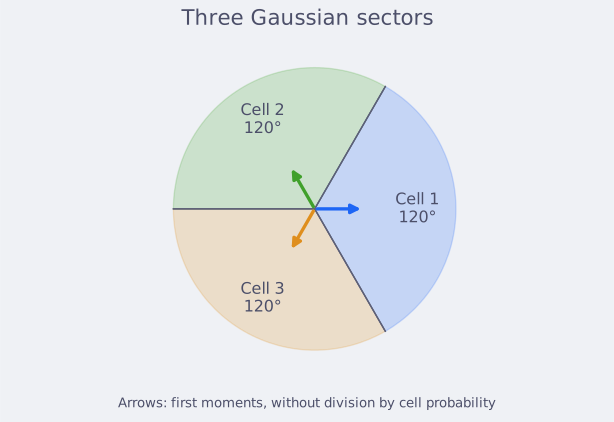
The drawing shows the exact planar geometry, clipped to a disk for display. Each sector extends to infinity; its arrow is the unnormalized first moment computed above. It is an illustration, not numerical evidence for the upper bound.
🏷️ Reduction to a finite family of scores
For fixed vectors , assigning to a cell maximizing maximizes the integral of the corresponding linear score. This turns an extremal partition into a conical partition, because multiplying by a positive scalar does not change which score is maximal.
A dual formulation normalizes and optimizes the expected maximum of these Gaussian scores. Compactness gives an extremizer. The manuscript chooses one with as few active cells as possible, where active means positive Gaussian measure. (OpenAI, 2026)
A useful elementary observation concerns merging two cells:
At a maximizer with the minimum number of active cells, this forces strict negativity of the pairwise inner products of distinct active centroids. A positive value would improve the objective; a zero value would preserve it while reducing the cell count.
This geometry confines an -cell extremizer to the span of its centroids, of dimension at most . The source uses the stronger structural consequences of the strict inner-product condition to organize the remaining argument.
🏷️ Deleting one score and comparing two residual scores
The manuscript takes the established three-dimensional theorem of Heilman, Jagannath, and Naor as an external input. That theorem is computer assisted. Together with the effective-dimension reduction, it handles configurations with at most four active cells. The new part aims to rule out a larger value when . (OpenAI, 2026)
One estimate deletes a score. Gaussian measures of translated convex cells obey an Ehrhard concavity principle: after applying the inverse normal distribution function, the measure has a useful concavity in the translation parameter. Differentiating in a carefully chosen direction bounds the loss when a cell is removed from the competition.
A second estimate studies competition against two residual scores. Their joint Gaussian covariance is a matrix, and its determinant quantifies how much independent variation remains. These two-score estimates complement the one-score deletion bound.
The manuscript combines the smallest centroid length with the three largest ones. Under the assumption that the objective exceeds , the resulting inequalities contradict the fact that the cell probabilities sum to one. The scalar comparisons include rational interval certificates. They were not executed in this exposition.
This architecture explains the role of the lower-dimensional input: the new estimates control all larger active-cell counts, rather than replacing the earlier computer-assisted case.
🏷️ Connection to clustering
Gaussian first moments appear in rounding procedures for kernel clustering. For the identity target, the manuscript describes a threshold involving
The optimization algorithm and the corresponding hardness statement require their own reductions. In particular, the cited hardness route uses a separate Unique Games input; it is not an unconditional complexity theorem derived from the Gaussian inequality alone.
Likewise, maximizing the first-moment functional with unrestricted cell masses is distinct from maximizing Gaussian noise stability under equal-mass constraints. The propeller theorem should be read with its actual objective and admissible partitions.
🏷️ Key steps and proof outlines
Duality makes the partition optimization finite dimensional
For a partition with moments , Euclidean duality gives
Substituting the moment integrals and optimizing the partition first replaces the right side by . For fixed , assign each Gaussian point to a maximizing score; ties can be resolved measurably. Thus arbitrary measurable cells can be replaced by polyhedral cones for the extremal problem.
The vector constraint is compact in fixed dimension and cell count, and the expected maximum depends continuously on the vectors. This gives an extremizer. The source uses product and empty-cell reductions to place the relevant finite problem in a common ambient dimension before selecting an extremizer with the fewest active cells. (OpenAI, 2026)
Minimal activity imposes strict centroid geometry
Merging cells changes the objective by . At a minimal-active maximizer, this forces for distinct active cells. Together with , this restricts the centroids to a simplex-like configuration in their span.
The winning-score cones depend only on the orthogonal projection onto that span. Integrating the independent Gaussian coordinates in its orthogonal complement changes neither their probabilities nor their first moments. With active cells, the effective dimension is at most . Therefore the established three-dimensional propeller theorem handles . The remaining task is a scalar contradiction for every , not another unrestricted partition optimization.
One-score deletion measures how much a small cell contributes
Remove one score from the competition and compare the expected maxima before and after deletion. Only points where that score wins can contribute to the loss. The cell is convex, and translating its boundary in the chosen direction produces a one-parameter family of Gaussian probabilities. Ehrhard concavity bounds the derivatives of the inverse-normal transform of those probabilities.
The source rewrites the resulting bound using the truncated-normal mean and variance. If is standard normal conditioned on , and , direct integration gives
These formulas connect a cell probability with its possible first moment. Rearrangement chooses the extremal one-dimensional event at fixed probability. The deletion bound then relates the smallest centroid radius to the objective that remains after removing it.
Two-score competition detects a missing transverse direction
The one-score estimate is not sufficient by itself. For the smallest cell, compare its winning condition against two selected competitors. The three score differences can be expressed through two residual Gaussian coordinates. Their covariance matrix is positive semidefinite, and its determinant records how much genuinely two-dimensional variation survives.
A nearly singular covariance means the competitors are almost redundant and can be treated by a one-dimensional estimate. A nondegenerate covariance yields a stronger restriction on how much probability the small cell can have while maintaining its prescribed first moment. The source derives this from the Gaussian geometry of its winning cone and conditional first moments. This supplements deletion with information about the relative directions of the largest centroids.
Radius inequalities exhaust all active-cell counts
Normalize the centroid lengths by the square root of the objective and order them. Their squared sum is one. The elimination section combines the smallest radius with the three largest, first bounding the third-largest radius and then separating the small-minimum regime from its complement. Each regime produces lower bounds on cell probabilities that cannot all fit inside total probability one if the objective exceeds .
The final scalar comparisons use rational interval enclosures and analytic estimates for normal tails. Their role is to certify an inequality over continuous parameter ranges, not to sample a few centroid configurations. Those certificates are source inputs to this outline and have not been rerun here.
The planar sector computation already supplies the matching value. The proof architecture therefore consists of an exact dual reduction, a known low-active-cell theorem, and new deletion/competition inequalities excluding every larger active count. The clustering consequences use additional rounding and hardness reductions and do not enter this analytic upper-bound argument.
See Also
Subgaussian marginals and logarithmic Sobolev inequalities develops concentration tools for log-concave laws. Euclidean vector balancing also turns geometric configurations of vectors into dimension-dependent sharp orders.
🏷️ Manuscripts and verification scope
- The Gaussian propeller bound in every dimension — pinned manuscript and companion source.
The family scope page describes selected formalization coverage. The scope covers the partition bound and its attaining sectors. It does not include the kernel-clustering consequences. No Lean build, axiom audit, or manuscript-to-formal-statement equivalence check was performed for these notes.
OpenAI collection provides prerequisites and the reading sequence; coverage register records completed and pending families.