Source and verification
This article explains family 011 of the October 6, 2026 OpenAI collection. Research conclusions are attributed to its manuscripts. The review covers statements, introductions, and selected proof mechanisms; it is not an independent verification of the complete proofs.
🏷️ Prime factors as a random partition
For , write its prime factors in decreasing order, with multiplicity: . After the list ends, put . The logarithmic proportions
are nonnegative and sum to one. Thus factorization produces a partition of unit mass. The largest part records the largest prime factor ; the complete partition contains much more information.
The Poisson–Dirichlet law can be defined without any number theory. Take independent uniform , form
and sort these fragments in decreasing order to obtain . The remaining unsplit mass after stages is , with expectation . It therefore tends to zero almost surely.
The central claim of this family is that the prime factors of , for uniformly sampled primes , have this same limiting law.
🏷️ Three related conclusions
The first manuscript develops weighted dilation graphs and claims, for every fixed ,
It then deduces that the totient fiber satisfies for infinitely many , for every fixed . The smooth-prime count has full power exponent, but does not by itself give a positive limiting proportion. (OpenAI, 2026)
The second manuscript claims the complete finite-dimensional law: for every fixed and bounded continuous ,
The weighting is ordinary and the limit holds through all real cutoffs. Here counts primes. (OpenAI, 2026a)
The third manuscript claims infinitely many primes with . The Möbius function equals one exactly when its argument is squarefree with an even number of prime factors. This parity conclusion requires additional signed estimates; it does not follow from the smoothness bound or from the limiting large-factor partition. (OpenAI, 2026a)
🏷️ From smooth predecessors to large fibers
Euler’s formula is
For a product of distinct primes , it simplifies to . If many candidate primes have predecessors supported on a small collection of primes, then many choices of can produce comparatively few totient values.
This is a pigeonhole mechanism: compare the number of subsets with the number of possible exponent vectors of their totients. Quantitative control of both counts is needed for the exponent ; the source supplies that product-and-pigeonhole argument after constructing its smooth primes.
An elementary example illustrates the collision rather than the asymptotic theorem: . Counting preimages and counting distinct values are different problems.
🏷️ Marked graphs and the parity barrier
A sieve can remove candidates divisible by small primes. Congruence information alone, however, may not distinguish prime candidates from composites with the wrong number of factors. The manuscripts supplement it with bilinear, or Type II, estimates: cancellation in sums over factorizations , with both variables substantial.
Marks record selected prime divisors of a predecessor. A physical graph state contains an integer and ordered lists of distinct marked divisors. An idealized operator instead samples prime labels independently with weights proportional to . Transference compares their high moments.
Repeated labels are the main obstruction to independence. Once a prime imposes a congruence, its later recurrence should not cost another independent factor . The source retains that congruence in a memory until its next use. Rank estimates for equalities among labels separate heavily constrained patterns from patterns preserving enough cancellation.
The full partition theorem adds a one-sided marked estimate. A determinant relation between primitive lattice vectors replaces the simpler integer graph. At a prime, a specified projective line has probability , and recurring lines again require memory. A two-sided comparison then removes marks from the prime average.
For the parity manuscript, the sign of a shared dilation occurs twice and cancels by . This permits parity-sensitive endpoint weights. A separate long-prime estimate allows a prime, rather than merely a rough integer, in the designated factor slot. Both modifications are needed for the claimed extraction.
🏷️ Recovering the probability law
Interior factorial-moment formulas count distinct prime-factor tuples whose logarithmic sizes have sum strictly below one. Such formulas alone do not exclude mass accumulating near the boundary of that simplex.
The source uses sequential size-biased sampling: choose a part with probability equal to its mass, remove it, and repeat. The limiting densities match the uniform stick construction. Their total mass is one, which excludes boundary loss. The expected residual mass then controls the error from sorting only finitely many sampled parts.
The largest-part consequence is the Dickman prediction. With on and for , the claimed law gives, for fixed ,
No uniformity for growing , and no recursive independence for later generations of prime-factor trees, is asserted.
🏷️ Key steps and proof outlines
Marked bilinear estimates extract primes from weighted candidates
The first paper starts with a nonnegative weight on candidates whose predecessor has only small prime factors. Its total mass is denoted by . A sieve removes small divisors of the candidate, but this leaves rough composites as well as primes. The key additional lemma is a bilinear estimate for the remaining composite factorizations.
Proof outline. Decompose a composite into two factor ranges. Unbalanced ranges are controlled by the initial sieve and estimates with one short factor. In balanced ranges the marked dilation graph compares the two factor variables. Expand a high moment as walks, recording each selected prime and every congruence it has already imposed. If a prime recurs, keep the previous constraint instead of charging another independent probability . Patterns with many independent constraints are sparse; the remaining patterns retain enough centered prime factors to cancel. This gives a balanced-composite upper bound of the form . Choose the small parameter after the constant is fixed. The positive main term then survives subtraction of both composite ranges. Finally divide the surviving mass by the maximum candidate weight, , to obtain distinct primes. A positive weighted mass alone would not give that count. (OpenAI, 2026c)
The totient exponent follows from two explicit counts
Fix and choose with . The smooth-prime theorem supplies primes at most whose predecessors are -smooth. Put .
Proof outline. Distinct -element subsets give distinct squarefree products by unique factorization. Their number satisfies
Every corresponding totient is at most and uses only primes at most . There are at most such primes, and each exponent is at most . Thus the number of possible totients is at most
Indeed, the logarithm of this count is , smaller than . Pigeonhole therefore gives a value with
To obtain infinitely many different values, observe that each fixed fiber is finite: if and , then and . These conditions allow only finitely many primes and exponents. Since the constructed fiber sizes grow without bound, their values cannot remain in a finite set. This completes the deduction from the source’s smooth-prime input.
Size bias turns factorial moments into a probability density
The second paper first proves an interior formula for distinct prime-factor tuples: on the simplex , , their limiting factorial-moment density is . This is a measure counting tuples, not yet a probability law for ordered large factors.
Proof outline. Choose factor masses sequentially, with probability proportional to their size among the remaining masses. An ordered tuple is selected with weight
Multiplication by the factorial density cancels every , leaving
Set . The inverse is , and its triangular Jacobian is . Therefore on the unit cube. Its total mass is exactly one, and the are independent uniforms. Compact subsets of the simplex can consequently capture arbitrarily close to all the mass. Interior convergence then excludes escape to its boundary, including configurations that run out of factors. This is the missing tightness argument that factorial moments alone would not supply. (OpenAI, 2026b)
Sorting requires a bound on the unseen mass
Let be the th largest of the first size-biased draws, padded with zeros, and let be the th largest of all masses. If the unselected total mass is , then
Proof outline. Removing masses cannot increase an order statistic. If , every mass at least must already have been selected, since any unselected mass is at most ; then the two order statistics agree. Otherwise their difference is at most . For a bounded continuous test of the first coordinates, with modulus of continuity , this gives
Use uniform continuity on and Markov’s inequality on its complement. The limiting expected residual is . First take the prime cutoff to infinity with fixed, then , and finally . Finite sorting is continuous, so the finite-draw limit and this error estimate establish the ranked Poisson–Dirichlet law.
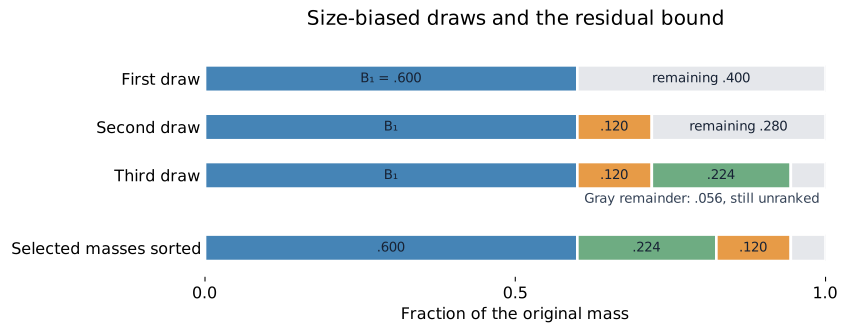
The illustration uses the deterministic choices , , solely to show the construction. The residual is an aggregate of all unseen fragments, not an additional ranked fragment. The inequality above controls their possible effect without guessing how that residual splits.
Parity extraction needs a separate squarefree step
In the third paper, candidates have the form . Their predecessor weight is
where is the designated group of marked primes and is nonnegative. The remaining prime slots contribute an even total multiplicity.
Proof outline. The factor selects odd multiplicity in the marked group. Thus supported is odd with odd, and is even. The signed marked estimates and the long-prime-slot estimate leave prime-candidate mass . The separate squarefree lemma removes only of that mass. On the survivors, parity counts distinct prime factors as well as multiplicity, giving . As the supported lies between and , arbitrarily large scales give infinitely many such primes. Without squarefree removal, the conclusion would only be . (OpenAI, 2026a)
🏷️ Connections
The joint Dickman law asks for independence across two adjacent integers. Counting totients counts distinct output values rather than unusually large fibers. Primitive roots uses controlled predecessor factorizations to limit possible order defects.
🏷️ Manuscripts and verification scope
- Weighted dilation graphs, smooth shifted primes and totient fibers — pinned manuscript and companion source.
- The Poisson—Dirichlet law for prime predecessors — pinned manuscript and companion source.
- Prime Predecessors with an Even Number of Prime Factors — pinned manuscript and companion source.
No family scope page was present at lean/docs/011.md in the pinned snapshot. This does not establish that all related formalization code is absent. No Lean build, axiom audit, or manuscript-to-formal-statement equivalence check was performed for these notes.
OpenAI collection provides prerequisites and the reading sequence; coverage register records completed and pending families.