Overview
Dembo, Peres, Rosen, and Zeitouni prove the sharp cover-time constants for Brownian motion on compact two-dimensional manifolds and for simple random walk on the two-dimensional discrete torus (Dembo et al., 2004). If is a smooth, compact, connected Riemannian surface without boundary and area , the time needed for Brownian motion to come within distance of every point is almost surely asymptotic to
If is the cover time of the side-length torus , then
in probability. Combined with Aldous’s earlier concentration result , this also identifies the expectation asymptotic.
The proof is a two-dimensional logarithmic-potential argument. On the unit torus, a fixed -ball is missed up to Brownian time with probability roughly , while there are roughly possible balls to cover; the competition between these two exponents gives the threshold . The lower bound is the hard part: the authors construct many candidate points with controlled multiscale excursion histories and use a second-moment argument to show that at least one small disk remains unvisited.
🏷️ Cover Time in Dimension Two
For a finite Markov chain, the cover time is
On the discrete torus
there are sites, and the simple random walk moves to one of the four nearest neighbors at each step.
For Brownian motion on a compact Riemannian surface , the pointwise cover time is not the right continuum notion: planar Brownian motion visits every small neighborhood of a point but does not hit every point of a two-dimensional continuum. The paper therefore studies the -cover time
Equivalently,
Dimension two is the borderline case. The walk is recurrent, so every fixed lattice site is eventually hit, but the Green function has a logarithmic singularity. A single prescribed site in has a hitting time of order . A coupon-collector heuristic then suggests one extra factor , hence . The theorem identifies the constant and proves that the strong correlations between nearby unvisited sites do not change it.
Two-Dimensional Cover-Time Constants
For Brownian motion on the unit flat torus ,
almost surely as .
More generally, let be a smooth, compact, connected, two-dimensional Riemannian manifold without boundary and area . Then
almost surely as .
Let be the cover time of simple random walk on . Then
in probability as .
The paper’s numbering is discrete first: Theorem 1.1 is the random-walk result, Theorem 1.2 is Brownian motion on , and Theorem 1.3 is the general compact-surface extension. The constants are consistent under diffusive scaling. Scale the side-length torus down to the unit torus. A simple random walk of steps corresponds to Brownian time about , because one step has covariance while standard planar Brownian motion has covariance . A Brownian -cover with therefore predicts
🏷️ The Annulus Computation
The local calculation is the gambler’s-ruin estimate for planar Brownian motion in an annulus. Suppose
and Brownian motion starts at radius from a point . Then the probability of hitting the inner circle before the outer circle is (by Kakutani’s Theorem)
This follows because is harmonic away from and has boundary values and on the two circles.
Choose small and , as in the paper’s upper-bound proof. Then a path started on has only probability
of hitting before returning to .
The second local input is the duration of the excursions used by DPRZ. Their excursion starts at , runs inward until it reaches , and then returns to . On the unit torus, uniformly for small , the mean duration of one such outer-to-outer excursion is
Moreover, sums of many such excursion durations concentrate around the corresponding multiple of this mean. The factor is the normalization of the two-dimensional Green function for Brownian motion with generator .
Combining these two facts, Brownian time corresponds to about
completed outer-to-outer excursions when . During each completed excursion, the outward leg from to has the hitting probability above. The chance that all these excursions miss is heuristically
The paper turns this into the uniform upper-tail estimate: for every fixed ,
for all , all starting points, all , and all small enough . Since , this is the estimate used below.
🏷️ Upper Bound
For the unit torus, the upper bound is a union bound after reducing the continuum to a controlled net. Take a maximal -separated set . It has
points, and if every net point has been hit at radius comparable to , then every point of the torus is covered at radius slightly larger than .
For a fixed net point , the tail estimate gives
Therefore
This tends to zero once
The paper implements this on the deterministic sequence and uses Borel-Cantelli plus monotonicity in to obtain the almost-sure bound
on the unit torus. The area factor is recovered in the manifold extension.
Why the net argument is legitimate
A small disk around an arbitrary point is contained in a slightly larger disk around a nearby net point. The proof uses this geometric fact with nested radii, so the Brownian path need not literally hit the net point. It only has to enter a disk whose radius is chosen with enough slack to cover the nearby continuum points.
🏷️ Lower Bound and the Multiscale Second Moment
The lower bound cannot be obtained by a direct independence argument. If two points and are close, then the events
are strongly correlated because Brownian excursions around and share their outer annuli. The proof resolves this by measuring how far down the sequence of nested annuli the path has penetrated.
Fix . The paper first chooses a rapidly decreasing sequence
and, for each large , sets
This gives the nested family
Around a candidate point , let denote the number of excursions from radius to radius before a prescribed number of outermost excursions has occurred. The outer count is fixed at
The excursion counts behave like a branching process. One excursion at scale creates a random number of excursions at scale before the path escapes back outward. By the logarithmic gambler’s-ruin estimate, this offspring distribution is close to geometric with mean near one. Thus
is approximately a critical Galton-Watson process run from the outside inward.
The authors call a point -successful if the innermost relevant count is zero,
and the intermediate counts stay in the narrow corridor
If is -successful, then the disk of radius around has not been hit by the time the outer excursions are completed.
For a single candidate point, Lemma 3.1 gives
Since the chosen square is partitioned into about candidate centers, the expected number of successful points grows like
which diverges for every .
The main technical work is the pair estimate. If and separate at scale , their excursion histories are essentially identical above and nearly independent below . The corridor prevents the common outer history from producing too many descendants at the splitting scale. Summing over pairs at each possible separation scale gives a second-moment bound strong enough that the number of successful points satisfies
along a suitable deterministic subsequence; Borel-Cantelli upgrades this to the almost-sure lower bound.
Proof: From a Successful Point to the Lower Bound
If is successful, then the Brownian path has completed many excursions at large scales around but has not entered . The total time of the outer excursions concentrates around its mean. With the paper’s choice
and with adjacent outer radii satisfying
the total time is
on the unit torus. On a surface of area , the same estimate is multiplied by .
Therefore, with high probability, some -ball is still unvisited at time
Since was arbitrary, this yields
This is the conceptual heart of the paper. The lower bound is not just a reverse union bound; it is a controlled construction of late points whose correlation structure is handled by the tree-like geometry of annuli.
🏷️ From Brownian Motion to Random Walk
The paper deduces the random-walk lower bound from the Brownian theorem by a strong approximation. Fix and set
The Brownian theorem implies that, with high probability, some disk of radius is still unvisited by Brownian motion on the unit torus up to time
A Komlos-Major-Tusnady type coupling, in Einmahl’s multidimensional form, constructs planar Brownian motion and simple random walk so that, after Brownian scaling and reduction modulo the unit torus,
with high probability. Hence if Brownian motion misses an -disk, the rescaled walk misses a disk of radius ; in lattice units the walk misses a disk of radius . Therefore it cannot have covered . Multiplying Brownian time by gives
Letting gives the random-walk lower bound. The matching upper bound is the known Aldous-Fill upper bound cited in the paper.
The factor of two
The Brownian constant on the unit torus is , while the random-walk constant is . This is not a contradiction. It comes from the diffusion normalization: standard planar Brownian motion has covariance matrix , while one step of the nearest-neighbor walk has covariance . One Brownian unit of time corresponds to about random-walk steps after scaling space by .
🏷️ General Compact Surfaces
The proof for a general smooth compact connected surface without boundary uses the same local annulus picture. First rescale the metric to reduce to area one. If the original metric is and the area is , then replacing by produces an area-one surface, and Brownian time scales by .
Locally, every smooth two-dimensional Riemannian metric is conformally Euclidean in isothermal coordinates. In such a coordinate patch, Brownian motion is a time change of planar Brownian motion. The time change affects how long an excursion takes, but not the logarithmic harmonic-measure computation that decides whether an excursion reaches the inner disk before escaping outward.
The mean duration of the relevant excursions is multiplied by , while the one-excursion hit probability inside a small annulus is still governed by the logarithmic harmonic function. Therefore the unit-torus constant becomes
Curvature and coordinate errors are lower order because the proof uses radii that shrink to zero and keeps fixed slack between adjacent logarithmic scales.
🏷️ How Fast Does the Cover Time Converge?
There is a sharp answer at the next order, but it should be read as a second-order asymptotic rather than a practical finite-size error bound. The convergence is logarithmically slow.
For Brownian motion on the unit two-dimensional torus, Belius and Kistler proved the subleading correction (Belius & Kistler, 2017). If
then their result is
in probability. Equivalently,
The negative correction means the true cover time is eventually a little smaller than the leading-order estimate .
For the discrete torus, Abe proved the corresponding second-order term (Abe, 2021). There is a constant such that, with probability tending to one,
Multiplying out gives
or, in the normalization used by DPRZ,
Thus the natural scale of convergence is not a power of ; the first visible correction is of order
This is very slow. At , for example, to three decimals, so the formal second-order correction is still about in the normalized units.
What this rate does and does not say
The second-order theorem locates the asymptotic center up to a window of order after normalization. It does not give a small- confidence interval, and the exponent is not meant as a numerically optimized finite-size bound. The correction eventually has negative sign, but modest simulations can still sit above because higher-order terms and lattice effects dominate until very large .
📊 Numerical Verification
The script
content/codes/2026 Summer/cover_times_2d_torus.py
simulates simple random walk on and reports the normalized cover time
The default run uses independent walks at modest sizes and writes the plot below. The dashed horizontal line is the DPRZ limit , while the dotted line is the center predicted by Abe’s second-order term,
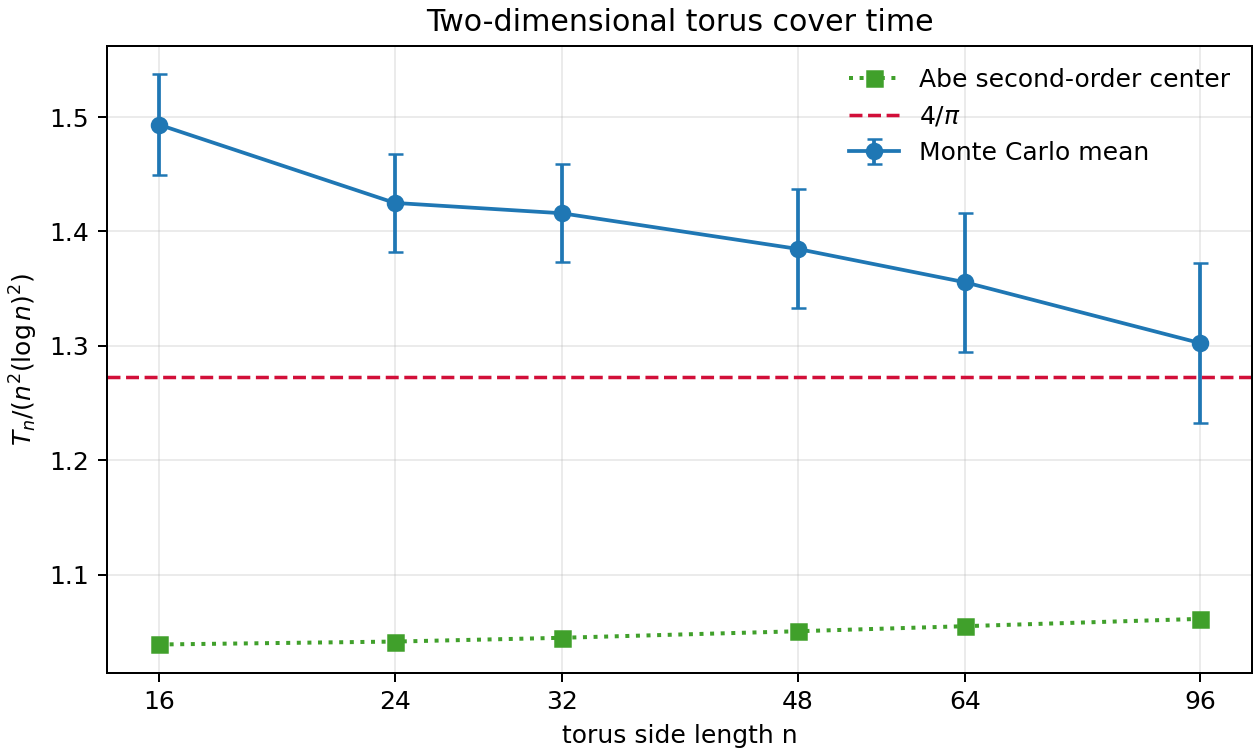
| side length | trials | mean | s.e. | 2nd-order center | mean - center | median |
|---|---|---|---|---|---|---|
| 16 | 256 | 1.4933 | 0.0226 | 1.0391 | 0.4542 | 1.4442 |
| 24 | 192 | 1.4250 | 0.0218 | 1.0416 | 0.3834 | 1.3623 |
| 32 | 160 | 1.4159 | 0.0217 | 1.0449 | 0.3710 | 1.3733 |
| 48 | 96 | 1.3848 | 0.0265 | 1.0506 | 0.3341 | 1.3616 |
| 64 | 64 | 1.3557 | 0.0311 | 1.0551 | 0.3006 | 1.3403 |
| 96 | 32 | 1.3024 | 0.0356 | 1.0615 | 0.2409 | 1.2574 |
The leading target constant is
The simulated means drift downward toward this value; at the difference from is about , smaller than one reported standard error. This is a reasonable sanity check of the leading DPRZ constant, not a precision estimate.
The second-order comparison is more instructive as a warning about scale. The formal center is below already for these , while the simulated means are still above . This does not contradict Abe’s theorem: after normalization, the unshown error window is of order , and is still about at . Numerically, the visible effect is only that the gap between the Monte Carlo mean and the second-order center decreases from at to at .
See Also
- on Dudley’s Theorem: Both topics use multiscale decompositions; Dudley’s theorem chains Gaussian increments, while the cover-time proof chains annular excursions.
- on Slepian’s lemma and Gaussian comparison: Useful background for comparison methods in Gaussian processes, which are conceptually close to the late-point heuristics for two-dimensional fields.
- on random matrices and complexity of spin glasses: Another example where a first-moment estimate is insufficient and the main work is controlling correlations through a second-moment argument.
- on second moments and extremal critical points of p-spin glasses: The successful-point construction is structurally similar to extremal-process proofs where rare candidates must be separated by their overlap or common history.