Overview
He and Huang construct explicit Runge—Kutta methods of arbitrary even order by recursively controlling Q- and D-type residuals (He & Huang, 2026). Their construction should be read against Stepanov’s Q/D formulation for order-ten explicit methods (Stepanov, 2025): Stepanov shows how branch-side and root-side order-condition defects can be made redundant through stage-order layers and repeated-node clusters; He and Huang turn that principle into a uniform algorithm based on Lobatto nodes, coordinate support separation, and two structured linear systems.
An -stage explicit Runge—Kutta method is a triple , where is strictly lower triangular, is the weight vector, and is the node vector. Applied to , it computes
and
The convention throughout is
where . This is the standard consistency condition used in the paper.
For each even , He and Huang’s construction produces a method with
stages. These counts are not asserted to be minimal. The point is the recursive certificate: instead of solving the nonlinear rooted-tree order equations directly, the construction places every residual generated by the order-condition recursion into a subspace that is later annihilated.
🏷️ Definitions and Order Conditions
Runge—Kutta order conditions are naturally indexed by rooted trees. If is a rooted tree, write for its number of vertices and for its tree factorial. Define the stage vector by
and, if ,
with componentwise product. The method has order at least exactly when
The first few conditions are
The first three are quadrature moment conditions. The last one is already an internal-stage condition: it asks whether information propagated through matches the Taylor expansion.
Butcher’s simplifying assumptions organize these conditions as
and
Here powers and are componentwise. The condition is quadrature. The condition is internal stage order. The condition is the left-sided companion condition that appears when the root of a tree is separated from its branches.
For explicit methods, high cannot hold literally. Since the second row of a strictly lower triangular gives , the condition would imply
so . Similar constraints propagate through early stages and conflict with nontrivial quadrature. The obstruction is not that and are irrelevant; it is that explicit methods can only satisfy weakened, residual versions of them.
🏷️ Q/D Residual Calculus
Define the -residuals
and the -residuals
Thus is the th equation and is the th equation. The central idea is to allow and to be nonzero, but only in directions that are killed by later contractions.
The order-three chain condition illustrates the mechanism. Since
one has
If holds, the first term is . The chain condition is therefore true provided . The residual does not need to vanish; it only needs to be invisible to .
At higher order, residuals are repeatedly acted on by , multiplied by powers of , and multiplied componentwise with other residuals. This is why the useful object is not an individual residual but a recursively closed residual space. With , He and Huang use
and, for ,
The corresponding row-vector spaces are
and, for ,
These definitions are closure statements. Every operation that appears in the rooted-tree recursion sends an allowed error to a next-level allowed error. This is why the proof can control all trees without enumerating their equations one by one.
🏷️ Stepanov’s Preceding Idea
Stepanov defines Q-type defects for arbitrary rooted trees by
so the usual subquadrature vectors are the height-one cases . He also defines D-type row defects
whose height-one cases are . In that language, the full order conditions split into quadrature conditions, Q-type conditions, and D-type conditions. Q-type conditions may contain several branch defects, while D-type conditions contain one root-side defect. This branch/root distinction is precisely the distinction that He and Huang encode in the spaces and .
Stepanov’s order-ten construction uses two organizing heuristics. Stage Order Layers make selected stages have enough stage order that many Q-type conditions become redundant. Counterpoised Node Clusters group stages with identical nodes and place mutually orthogonal Q- and D-subspaces on each cluster; this is what lets D-type moment conditions vanish by cancellation inside a repeated-node cluster. This leads to a seven-parameter family of explicit order-ten methods with 15 stages.
He and Huang preserve the cancellation logic but make it systematic. Instead of designing a special order-ten architecture, they prescribe recursive spaces, support regions, and repeated-node clusters for every even order. The price is that their order-ten member uses 22 stages rather than Stepanov’s 15. The gain is a uniform construction with a proof that reduces coefficient generation to two structured linear systems.
🏷️ Sufficient Q/D Conditions
Let satisfy
The paper proves that order follows from
and
This is a routing theorem. Pure powers of are handled by . Branch-level residuals are routed into the hierarchy and killed by . Root-level residuals are routed into the hierarchy and killed by . Mixed branch/root terms are killed by . Products of Q-residuals remain controlled by .
The recursion works because it replaces a large nonlinear family of rooted-tree equations by an invariant-subspace statement: every error term produced by the tree recursion stays inside a space that the construction knows how to annihilate.
🏷️ Recursive Tableau Construction
For even , set
Then
The node vector is built from the -point Gauss—Lobatto rule on . Since this rule is exact through degree , the moment conditions are built in. When a Lobatto node is repeated across several stages, the corresponding quadrature weight is split across that repeated-node cluster.
The stage indices are divided into coordinate regions. The weights live on the first region, the residuals are forced into the middle region, and the residuals are forced into the last region. Hence
by support separation.
The entries of are then determined as follows.
- Choose the Lobatto nodes and initialize .
- Initialize .
- Solve the D-system in the bottom-right part of , enforcing the recursive inclusions for .
- Insert those coefficients into .
- Solve the Q-system in the left part of , enforcing the recursive inclusions for .
- Return the explicit tableau .
The D-system is solved first because the Q-equations use the bottom-right coefficients already fixed by the D-equations. Once the support pattern is chosen, both systems are linear. This is the constructive content of the paper: the nonlinear rooted-tree order problem is converted into two structured linear solves.
The stage counts for the first few even orders are:
| order | stages |
|---|---|
These counts are upper-bound construction counts, not minimality claims.
🏷️ The Order-Six Mechanism
For ,
The four Lobatto nodes on are
The construction arranges
and
The zero weight at stage is intentional: this stage belongs to the Q-block, so it can carry a branch residual without being seen by .
For the generated order-six tableau,
but, rounded to six significant digits,
Thus fails, but it fails in a harmless coordinate. Since , this residual is killed by the final weight contraction.
Similarly,
while
The two nonzero entries sit at repeated copies of the same Lobatto node and cancel in the relevant cluster moments. This is the D-side analogue of the Q-block cancellation.
📊 Numerical Verification
The authoritative verification script is
content/codes/2026 Summer/qd_rk_bigfloat_verification.jlIt generates the tableaux by the recursive algorithm, using Julia BigFloat arithmetic throughout coefficient generation and rooted-tree checking. The saved coefficient file is decimal text, not a binary double array:
content/codes/2026 Summer/qd_rk_tableaux_p4_p14_bigfloat.txtThe script performs the following steps for each even order :
- construct the -point Lobatto rule on in high precision;
- assemble the Q-block nodes, D ghost nodes, and D triangular repeated-node clusters;
- split each Lobatto weight across the stages carrying that node;
- solve the D-system in BigFloat arithmetic;
- solve the Q-system in BigFloat arithmetic using the D coefficients just computed;
- enumerate all unlabeled rooted trees through order ;
- verify
for every rooted tree .
The high-precision run is
julia 'content/codes/2026 Summer/qd_rk_bigfloat_verification.jl' --orders 4 6 8 10 12 14 --dps 80 --save 'content/codes/2026 Summer/qd_rk_tableaux_p4_p14_bigfloat.txt'The completed BigFloat output confirms all even orders :
| order | stages | rooted trees checked | max tree residual | max residual | row-sum residual |
|---|---|---|---|---|---|
The generated systems also close at high precision:
| order | D unknowns | D solve residual | Q unknowns | Q solve residual |
|---|---|---|---|---|
As an independent sanity check, the same BigFloat tableaux were applied to
and compared with the exact value . This nonautonomous test uses the stage nodes explicitly. The log-log plot shows the expected slopes under step refinement.
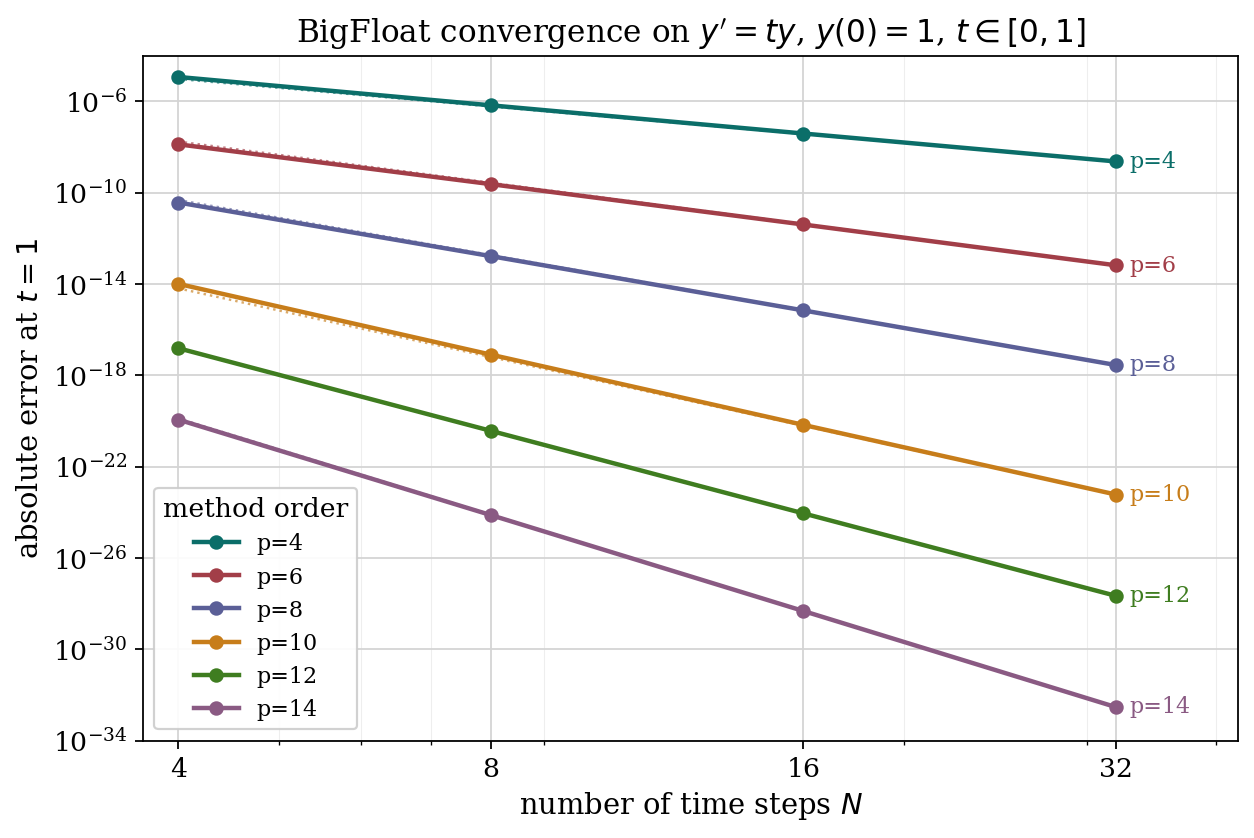
These ODE runs do not replace the rooted-tree verification; they check the expected convergence behavior on a problem with a known exact solution. The rooted-tree computation is the stronger nonlinear order check.
🏷️ Order-Ten Assembly
For ,
The construction uses a six-point Lobatto rule. The D-system has unknowns, split by levels as
and the Q-system has unknowns, split as
Stepanov’s order-ten construction uses 15 stages, so it is substantially tighter at this order. He and Huang’s order-ten member should therefore not be read as a best-known order-ten method. Its role is different: it is the instance of a uniform even-order recursive family.
🏷️ Interpretation and Limitations
The construction separates three tasks. Lobatto quadrature supplies the moment conditions . Support placement makes Q-residuals invisible to and separates them from D-residuals. Repeated-node clusters make D-residual moments cancel. The coefficient problem then splits into a D-system followed by a Q-system.
The Q/D conditions are sufficient, not necessary. They do not characterize all explicit Runge—Kutta methods of a given order, and the stage count is an upper-bound construction rather than a minimality theorem. Free parameters can still influence stability regions and error constants; algebraic order alone does not determine practical performance.
Links
- on From ODE45 to others gives the practical MATLAB-side viewpoint on explicit Runge—Kutta solvers and when nonstiff one-step methods are a reasonable default.
- on Wave Equation with PML includes explicit Runge—Kutta—Chebyshev time stepping, where stability rather than only algebraic order controls performance.
- on epsilon extrapolation connects to extrapolation methods, which have the same leading stage-growth scale.
- on Crouzeix’s conjecture is useful background for thinking about stability through polynomial bounds on matrices.