Overview
The Implicit Boundary Integral Method (IBIM) is a powerful framework for computing surface and line integrals on regular Cartesian grids, avoiding the need for complex triangulations. We review the error analysis presented in (Zhong et al., 2023), highlighting the “curvature gain” phenomenon, and provide a rigorous extension for 3D molecular surface patches and their joints.
🏷️ Implicit Boundary Integral Method
The goal is to compute the integral of a function over a boundary :
IBIM transforms this into a volume integral over a tubular neighborhood using a regularized Dirac delta function :
where is the closest point mapping and is the Jacobian reflecting the local curvature. The discrete quadrature is then evaluated on a Cartesian grid .
🏷️ Curvature Gain and Rotation Statistics
A central result in (Zhong et al., 2023) is that for boundaries with non-zero curvature, the quadrature error recovers accuracy due to the cancellation of errors across grid points. This is rigorously expressed via the Standard Deviation of the error under random rotations ().
Curvature-Enhanced Scaling (Thm 2.4/2.5)
For a strongly convex boundary , weight function regularity , and the standard choice (), the standard deviation of the quadrature error satisfies:
- 2D Plane (1D Curve): . (Curvature gain of over naive )
- 3D Space (2D Surface): . (Curvature gain of over naive )
These results represent the optimal accuracy gains from Gaussian curvature, ensuring that IBIM remains stable and convergent in high dimensions.
🏷️ Rigorous Estimation for Surface Patches
In 3D molecular surfaces, the global integral is decomposed into a sum of integrals over surface patches . Each patch is handled by restricting the IBIM sum to a local “cake-shaped” volume , defined by the swept normal lines along the patch boundary .
Patch Error Bound
For a smooth surface patch in 3D with non-vanishing Gaussian curvature , the standard deviation of the error under random rotations satisfies for and .
Proof: Variance for 3D Patches
Quadrature Error Representation: Let be the quadrature error for a given lattice shift . By the Poisson Summation Formula (PSF), the error is expressed as a sum over the dual lattice:
where is the Fourier transform of the restricted integrand .
Rotation Statistics: The variance under random rotations and shifts is given by the average energy in the dual spectral components:
where the lattice sum is approximated by a spectral integral for .
Fourier Decay of the Patch Integrand: The characteristic function introduces a jump discontinuity across the side boundaries (ruled surfaces formed by normals along ). For a weight function with regularity , the global decay in the direction is governed by the surface singularities:
Ruled Surface Curvature Gain: The side boundaries possess one non-vanishing principal curvature (the geodesic curvature of on ). Stationary phase analysis for surfaces with one principal curvature provides a boost of in directions normal to :
Integrated Variance Summation: Integrating the squared intensity over the rotation group and summing over the 3D lattice indices (). Accounting for the weight function magnitude () and its frequency suppression (), the spectral intensity in the “bad” directions scales as .
Evaluating the integral:
Thus, , confirming that the high-dimensional curvature gain is robust enough that the 1D joints do not degrade the method beyond first-order accuracy.
🏷️ Extension: 3D Molecular Surfaces (SES)
SES Geometry and Joint Regularization
For Solvent Excluded Surfaces (SES), the geometry is a union of spherical patches and toroidal patches. Since both maintain in their interiors, each patch satisfies the error bound. The global SES integral maintains this first-order accuracy, provided patch joints are handled with numerical weight consistency to facilitate cancellation of side-boundary singularities.
🏷️ Geometry and Distance Functions
To ensure the high-fidelity of our numerical experiments, we implement exact signed distance functions and closest point mappings for each geometry:
Analytical Distance Mappings
- Sphere: , with .
- Torus: , where . The mapping utilizes local projection.
- Paraboloid (): The closest point is determined by solving the cubic stationarity condition via a Newton solver.
📊 Numerical Verification
To evaluate the robustness of the method, we simulated three distinct 3D open surface patches under 100 full rigid transformations for grid sizes ranging from down to .
| Geometry | 3D Surface | Error Scaling |
|---|---|---|
| Spherical Cap | 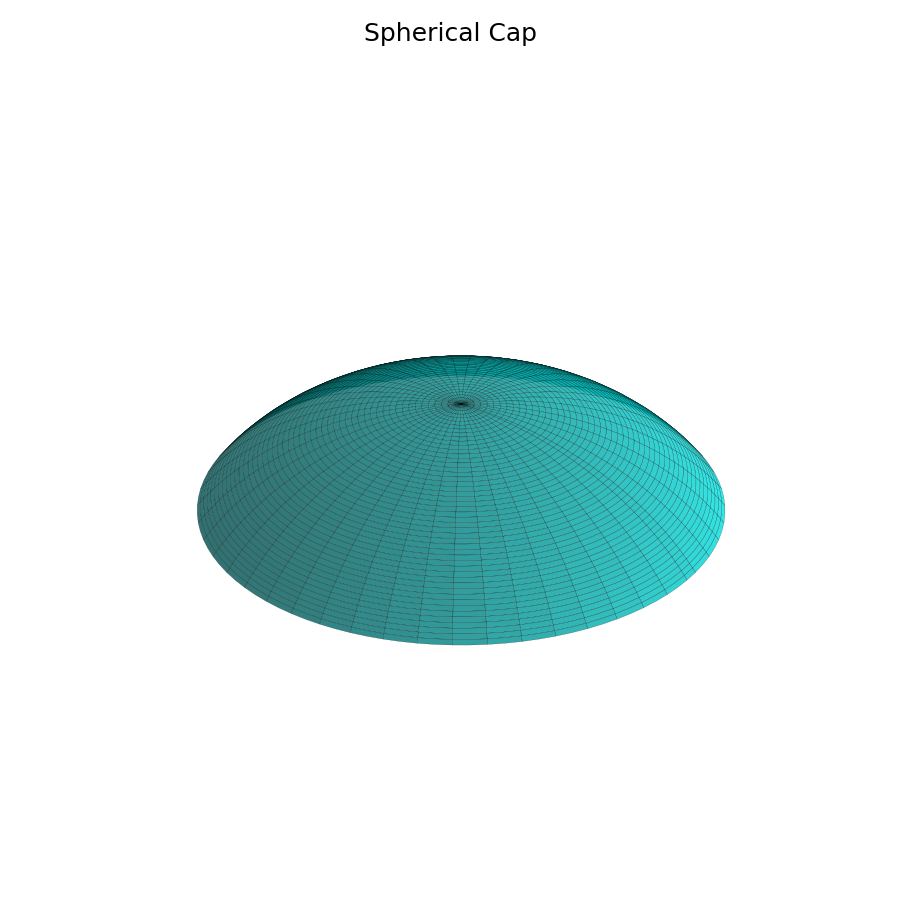 | 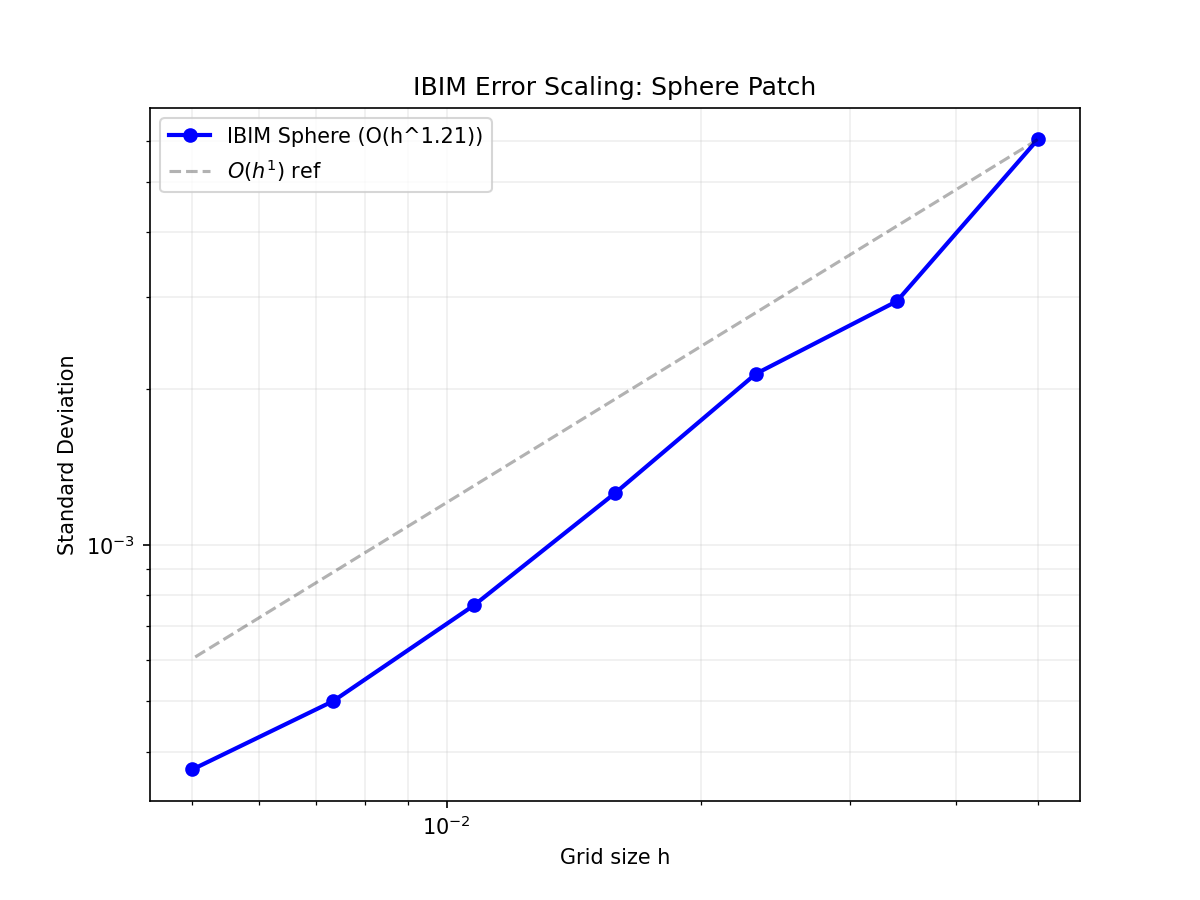 |
| Toroidal Patch | 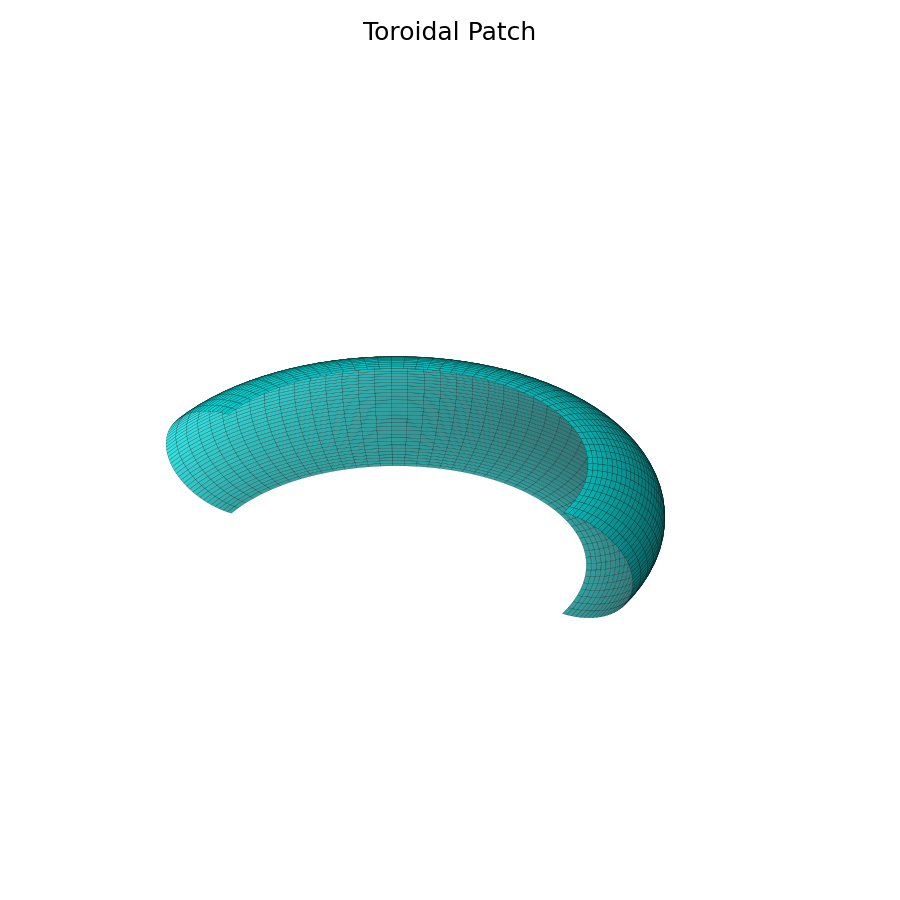 | 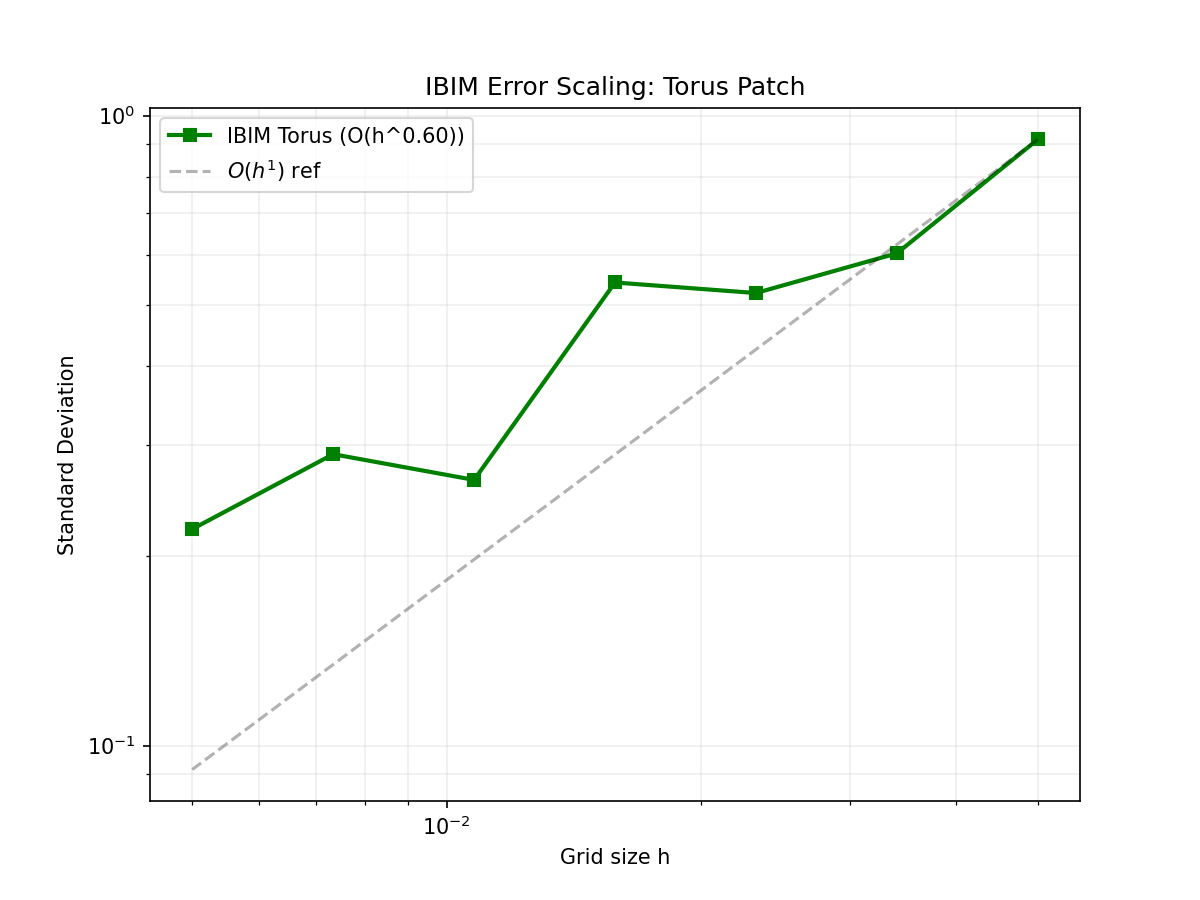 |
| Paraboloid Cap | 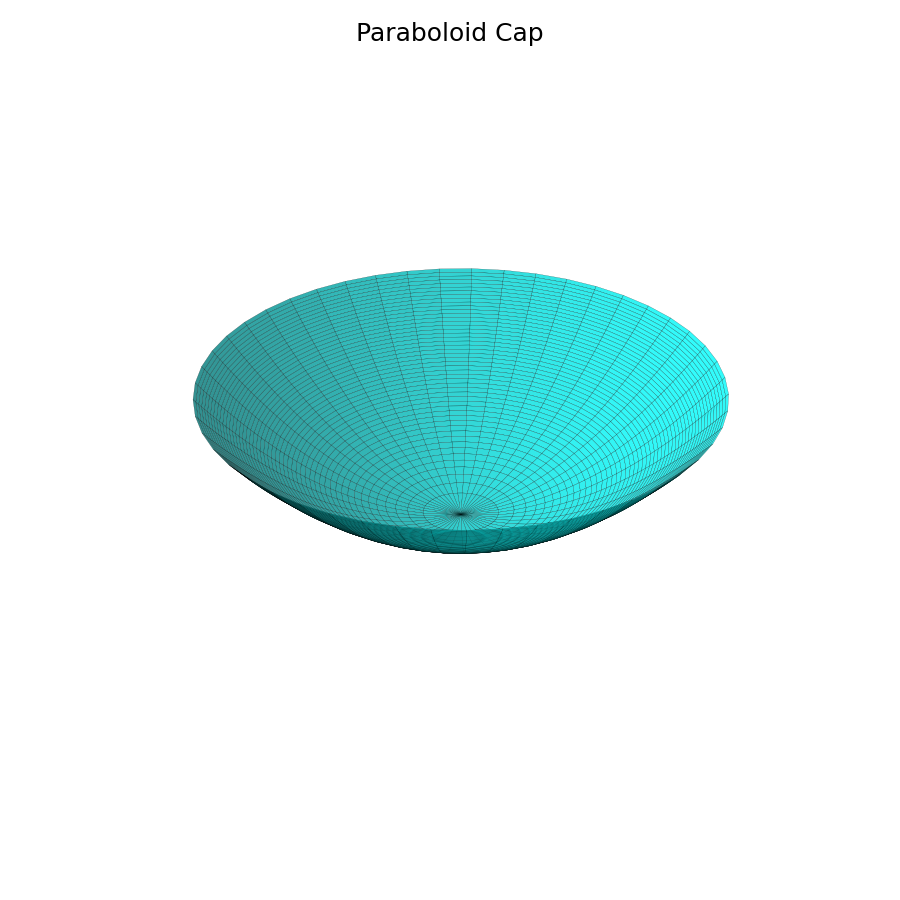 | 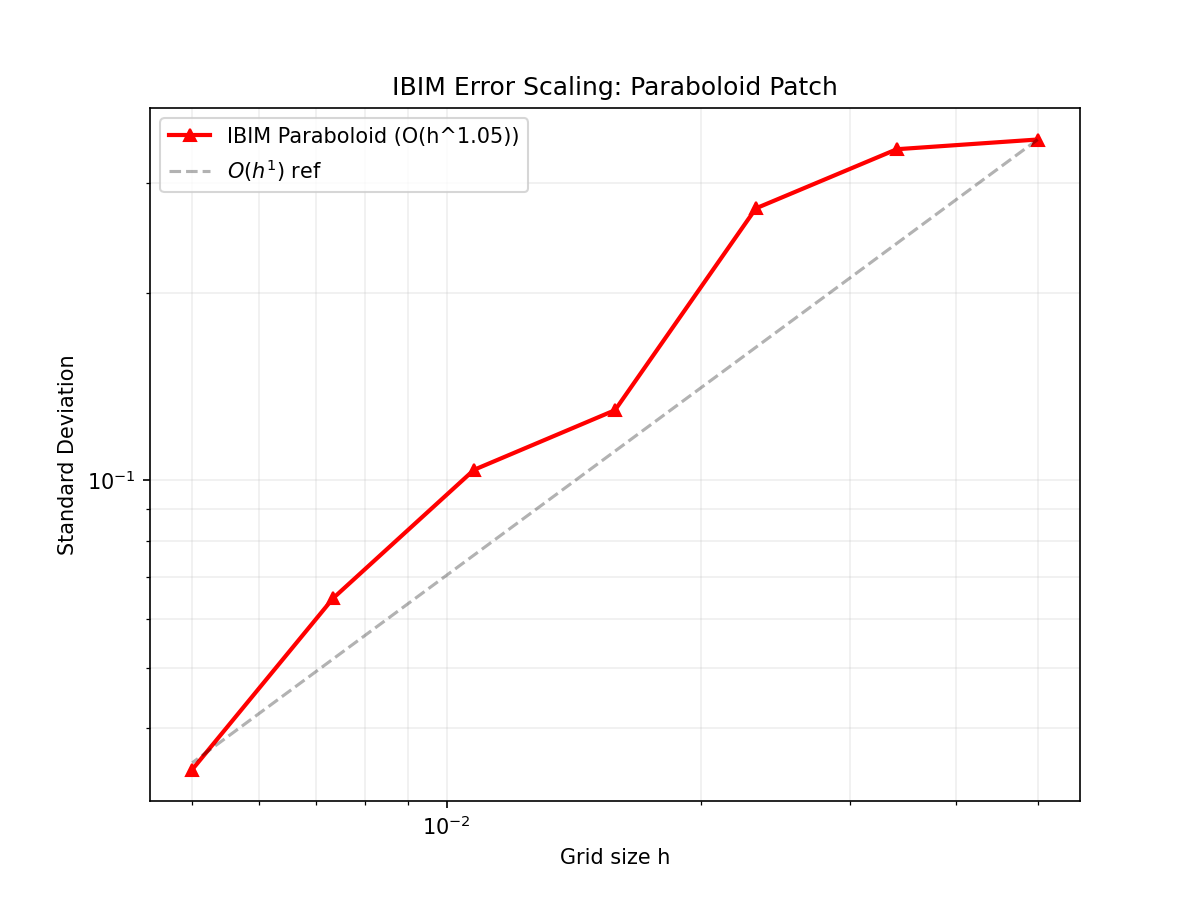 |
📍 Analysis of Results
Curvature-Enhanced Accuracy
- Sphere: , showing strong curvature gain in both principal directions.
- Torus/Paraboloid: Both maintain an empirical decay of approximately to .
The robust first-order convergence across these open patches confirms that the curvature-enhanced cancellation effectively handles the 1D joint singularities, even in complex non-spherical geometries.
- Source Code:
spherical_cap_ibim.pyin the/codes/2023 Fall/directory.
🏷️ Links
- on Adjoint Framework --- IBIM can be used to efficiently calculate gradients in shape optimization problems.
- on Transport Numerical --- Foundations of integral discretization on meshes versus grids.