Overview
The time-dependent radiative transport equation (RTE) coupled with the material temperature equation describes the evolution of radiation and heat in a participating medium. We derive the decoupled integral formulation for the scalar flux and discuss the grey approximation used in numerical simulations.
🏷️ Mathematical Formulation
The coupled system for radiation intensity and material temperature is given by:
where is the absorption coefficient, is the speed of light, and is the material heat capacity. is the Planck function:
🏷️ Grey Approximation
In many applications, we assume the material properties are independent of frequency (the grey medium approximation). Integrating the Planck function over all frequencies yields:
where is the radiation constant. Defining the scalar flux and assuming isotropic emission, the equations simplify to:
🏷️ Optical Depth and Heterogeneous Media
In realistic media, the absorption coefficient is a function of position, frequency, and local temperature, . This introduces strong nonlinearities into the coupled system. For the grey approximation, we define the optical depth along a ray between two points and :
The attenuation of radiation intensity is then governed by , representing the probability of a photon traveling between these points without being absorbed.
Varying Opacity
When varies spatially, the integral formulation for the scalar flux becomes:
For numerical efficiency in the treecode, if is relatively smooth, we can approximate the optical depth using the average opacity between the target and the source cluster: . Smoothness is critical here, as the treecode’s far-field approximation assumes the kernel (which depends on ) varies slowly across the source clusters. High-frequency oscillations or sharp discontinuities in would require much smaller clusters or higher-order multipole expansions to maintain accuracy.
🏷️ Integral Formulation
By treating the transport equation as a first-order linear PDE along the characteristic rays and , we can write the solution using the method of characteristics. Let and , the transport equation becomes:
where . Integrating along the ray from the boundary or from :
Integrating over all directions gives the scalar flux :
Changing variables (where and ), we obtain the general volume integral:
This is an integral with a retarded Green’s function, where the attenuation factor is determined by the accumulated optical depth between the source and the target.
🏷️ Integro-differential Equation for Material Temperature
By substituting the integral expression for into the material temperature equation, we obtain a closed-form nonlinear integro-differential equation. It is often computationally convenient to solve for the radiation energy density . Using the chain rule, the evolution of is governed by:
where represents the retarded integral operator:
This formulation highlights the non-local and retarded nature of the coupling. In the limit of high opacity (), the system relaxes towards local thermodynamic equilibrium where .
And solving this can apply some fast algorithm like treecode or FMM as we did before.
🏷️ Numerical Algorithm
The solver utilizes a time-marching scheme that alternates between evaluating the non-local scalar flux and updating the local energy density through a semi-implicit relaxation.
🏁 1. Initialization
Initialize the material temperature and compute the equilibrium radiation energy density . The initial emission source is set to .
⏳ 2. Time-stepping Loop
For each time step , the following operations are performed:
A. Retarded Potential Integration Evaluate the scalar flux via the retarded volume integral over the domain :
- Treecode: Clusters distant sources to accelerate the summation from to .
- Composite Simpson: Computes the accumulated optical depth along the ray path using a multi-interval quadrature of .
- History Interpolation: Retrieves the source term at retarded times using a temporal history buffer and linear interpolation.
B. Semi-implicit Energy Relaxation Evolve the radiation energy by solving the stiff material coupling equation. We employ a semi-implicit Euler scheme for numerical stability as increases:
C. Source Synchronization Update the isotropic emission source and append the new values to the history buffer for use in future time steps.
🏷️ 2D Implementation and Treecode Acceleration
In the 2D spatial domain, the scalar flux satisfies an integral equation involving a retarded Green’s function. By approximating the kernel, we can express as:
where and is the source term proportional to . This integral can be accelerated using a Treecode algorithm. The core idea is to cluster distant sources and represent their contribution using a single far-field approximation at the cluster’s center of mass.
Treecode for Retarded Potentials
For time-dependent problems, the treecode must account for the retarded time . When evaluating the contribution of a distant node to a target point , we use:
where is the distance from to the center of node . This reduces the complexity from to .
📊 Numerical Verification
We implemented the time-domain RTE solver in 2D using an optimized quadtree-based treecode. The system was discretized on an 80x80 grid with a refined time step to capture the fast transient dynamics of radiation transport. The simulation features a complex initial thermal profile (multiple Gaussian peaks and a periodic background) and smooth heterogeneous fields for both opacity and heat capacity .
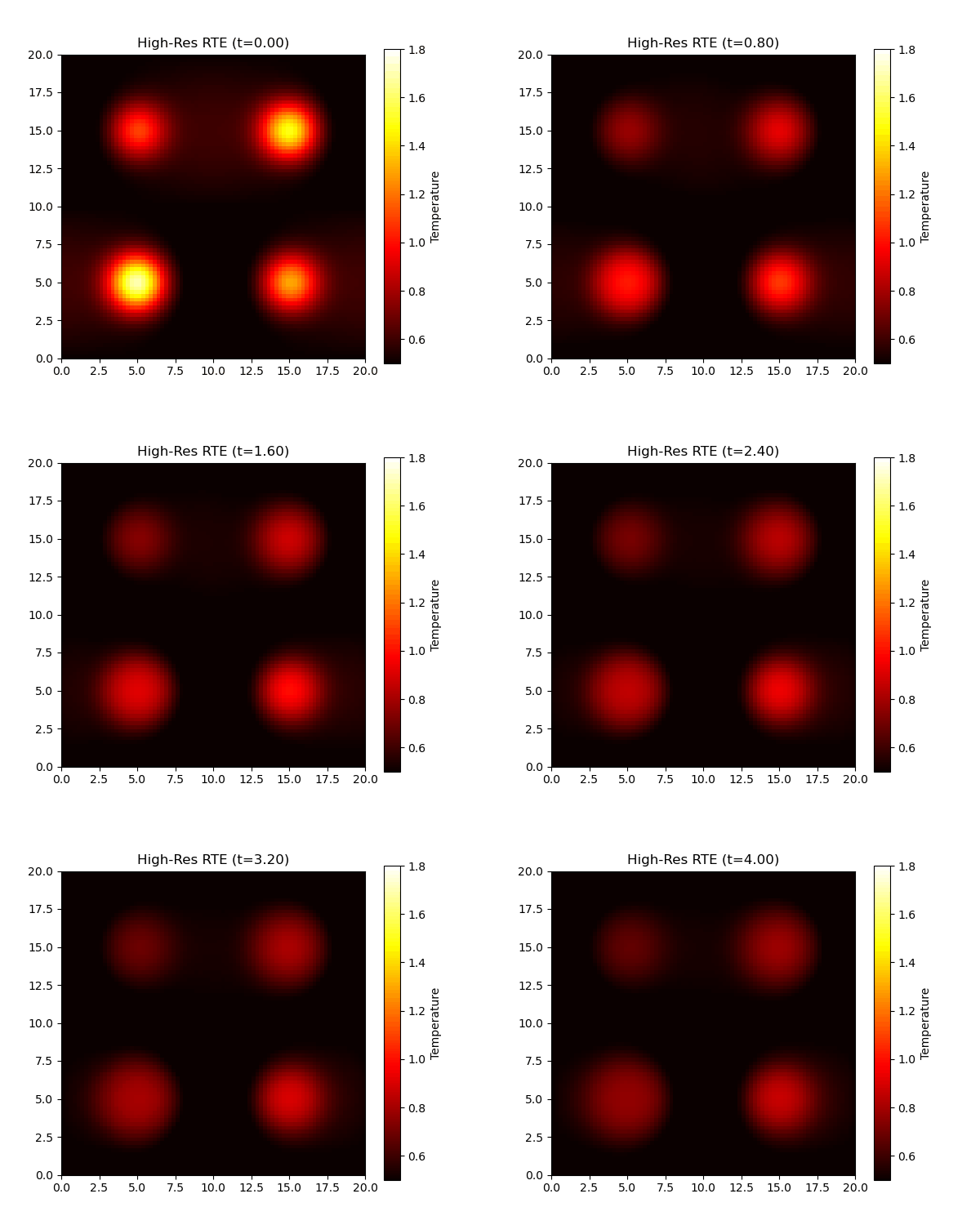
The animation illustrates the high-resolution dissipation and expansion of the thermal energy through radiation over time, influenced by the spatially varying material properties. The treecode maintains complexity, allowing for efficient simulation of large-scale problems while ensuring numerical stability via semi-implicit energy relaxation.
- Source Code:
on_Time_domain_RTE.pyin the/codes/2016 Fall/directory. - Results: The final temperature distribution shows the expected smoothing and expansion of the thermal front.
Links
- on Adjoint Framework --- The adjoint method can be applied to this transport system for parameter estimation of .
- on Transport Numerical --- Early notes on transport equation discretization.